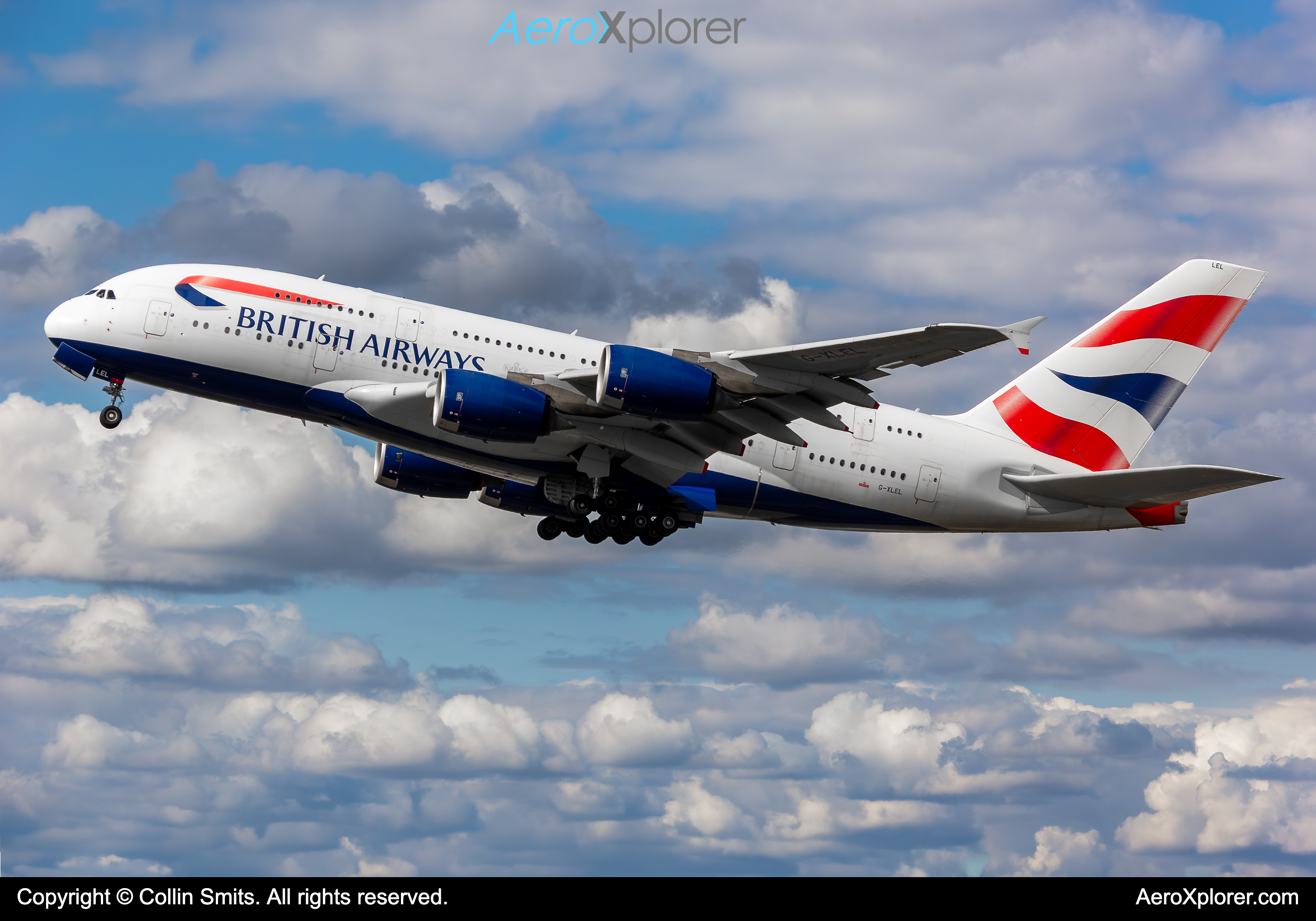

A British Airways Airbus A380 completed an unusual journey this week, spending nearly seven hours in the air before landing at the same airport from which it departed. The cause was a weather radar failure that made continuing the long-haul route to London impractical.
The aircraft, operating flight BA54 from O.R. Tambo International Airport in Johannesburg to London Heathrow, departed as scheduled but never reached its destination. Instead, the crew turned the double-decker jet around and brought it back to Johannesburg, where it landed safely after the extended flight.

What Happened on the Flight
According to reports from Simple Flying and other aviation outlets, the A380 registered as G-XLEJ took off from Johannesburg, already more than five hours behind its original schedule due to ground delays, and headed north toward London Heathrow. The flight climbed to a cruising altitude of 34,000 feet and progressed normally over Botswana and Zambia for more than two hours before the crew, by then over the Democratic Republic of Congo, identified an issue with the aircraft's weather radar system.
Weather radar plays a critical role on long-haul flights, particularly those crossing regions known for severe convective activity. The route between Johannesburg and London passes over parts of Africa where thunderstorms and turbulent weather systems are common, especially at cruising altitude. According to reports, the radar briefly displayed a warning message shortly after takeoff that cleared, but persistent clutter on the radar display never dissipated, rendering it unreliable for detecting hazards; the backup radar was also reported to be inoperative.
Faced with the prospect of continuing into airspace where storms could not be safely navigated, the crew made the decision to return to Johannesburg. The flight spent approximately seven hours airborne before touching down back at its origin.
Why the Aircraft Returned to Its Origin
Because the malfunction was identified only a few hours into an eleven-hour-plus journey, Johannesburg remained the most practical airport to return to. The operational realities of flying the world's largest passenger jet reinforce that logic: the A380 requires specialized ground handling equipment, dedicated gates capable of accommodating its size, and airports certified to receive the type, meaning few airports along the route between Africa and Europe could properly service the aircraft on short notice.
Returning to Johannesburg allowed British Airways to handle passengers, crew, and the aircraft itself using established facilities and personnel already in place for the outbound service. It also positioned the jet for maintenance work on the faulty radar system without the logistical complications of a diversion to an unfamiliar airport.
Fuel Considerations and Safety
Long-haul aircraft like the A380 carry substantial fuel reserves, but a flight of this length requires careful fuel management. Because the aircraft was too heavy to land safely so soon after departure, the crew descended to 25,000 feet and held in a pattern north of Johannesburg for roughly two hours, burning fuel to bring the aircraft down to a safe landing weight before returning to the airport.
The decision to turn back rather than press on demonstrates the conservative approach airlines take when safety-critical systems malfunction. Weather radar failures do not immediately endanger an aircraft, but they remove a key tool pilots rely on to make informed routing decisions during flight.

Analysis: How Spirit Airlines Changed Airline Pricing, then Paid the Price
Impact on Passengers
Passengers on board experienced a full flight duration with no destination change to show for it, following ground delays of more than five hours before the flight had even departed. All passengers and crew returned to the terminal in Johannesburg without incident.
Flights that return to their origin, sometimes called flights to nowhere, occur occasionally in commercial aviation. While frustrating for passengers, such returns reflect the strict safety protocols airlines follow when technical issues arise mid-flight.
Following maintenance checks and repairs to the weather radar system, the same aircraft was cleared to fly again.
Passenger Threatens to "Take Over" Alaska Airlines Aircraft, Rebooked on a Later Flight » FAA Investigating After Two American Airlines Flights Flying Towards Each Other Share Same Callsign Mid-Air » Powerful 7.4-Magnitude Earthquake Disrupts Operations at Several Colombian Airports »

Comments (0)
Add Your Comment
TAGS
NEWS BA54 British Airways A380 Airbus A380 G-XLEJRECENTLY PUBLISHED
 FAA Investigating After Two American Airlines Flights Flying Towards Each Other Share Same Callsign Mid-Air
An air traffic controller prevented a possible disaster when two American Airlines aircraft flying toward each other were assigned flying with identical callsigns.
NEWS
READ MORE »
FAA Investigating After Two American Airlines Flights Flying Towards Each Other Share Same Callsign Mid-Air
An air traffic controller prevented a possible disaster when two American Airlines aircraft flying toward each other were assigned flying with identical callsigns.
NEWS
READ MORE »
 FAA Eases, But Doesn't Lift, SFO's Parallel Landing Restrictions
NEWS
READ MORE »
FAA Eases, But Doesn't Lift, SFO's Parallel Landing Restrictions
FAA Eases, But Doesn't Lift, SFO's Parallel Landing Restrictions
NEWS
READ MORE »
 British Airways Sued Over Head Injury, But the Real Story Is More Complicated
A passenger is suing British Airways over a head injury she says a flight attendant caused, but the airline's crew member wasn't at fault.
NEWS
READ MORE »
British Airways Sued Over Head Injury, But the Real Story Is More Complicated
A passenger is suing British Airways over a head injury she says a flight attendant caused, but the airline's crew member wasn't at fault.
NEWS
READ MORE »
More than just headlines.
Get unlimited ad-free access to in-depth aviation news, premium stories, and exclusive insights other sites don't cover.
- Ad-free browsing on AeroXplorer
- Unlimited access to premium and exclusive articles
- Higher photo upload limits & commissions on sales
- Free access to Jetstream Magazine on higher tiers
- Ad-free browsing
- Sell aviation photos with 60% commission
- First week free!
- Everything in Basic+
- Unlimited premium articles
- Sell aviation photos with 70% commission
- Free Digital subscription to Jetstream Magazine
- First week free!
- Everything in Basic+ and Pro
- Sell aviaiton photos with 80% commission
- Early access to exclusive stories
- Free Digital+Print subscription to Jetstream Magazine