
A machined titanium bracket can be flawlessly manufactured, signed off by an inspector, ready to be bolted onto a wing, and still sit on a shelf for days. Not because anything is wrong with the part, but because the paperwork proving its perfection isn't finished yet.
That gap, between a good part and a shippable one, forms the basis of GroundControl, a young Bay Area software company that used last week's Farnborough International Airshow to make the case that AI can close it.
Every part on every aircraft needs documentation proving it matches the drawing before it can legally leave the factory. GroundControl, founded in 2024 and backed by Y Combinator, has built its business around making that documentation faster to produce and, increasingly, around helping the companies buying those parts make sense of the paperwork once it arrives.
Fast Facts: GroundControl
| Headquarters | San Jose, California, United States |
| Founded | 2024, by Mehul Shah (CEO), Nick Warren, and Matthew Noseworthy (CTO) |
| Backing | Y Combinator (X25 batch), roughly $3 million in seed funding |
| Flagship products | AS9102 First Article Inspection Report (FAIR) software; an AI-powered PO and quote review tool |
| Compliance | ITAR-registered, NIST SP 800-171 compliant, AWS GovCloud-hosted; recently completed FedRAMP Moderate Equivalency; registered under Canada's Controlled Goods Program (CGP) |
| Traction | 70+ manufacturing facilities on the platform, generating close to 1,000 inspection reports a month, per the company |
| Web | gndctl.com |
AeroXplorer sat down with GroundControl representatives, including co-founder and COO Nick Warren, on the show floor to talk through the company's products, its approach to security, and how it's navigating an aerospace and defense compliance landscape that shifted meaningfully just days before the show opened.
Built From Inside the Problem
GroundControl's origin story is less Silicon Valley and more shop floor. Co-founder and CEO Mehul Shah spent eight years building software for his family's printed circuit board manufacturing business before starting the company, a detail he's cited directly in describing what led him to GroundControl. That background shows up in the product: instead of building generic quality-management software and hoping aerospace customers would adapt to it, the founding team built specifically around AS9102, the aerospace industry's standard for documenting First Article Inspections, and the broader AS9100 quality framework it sits inside.
The thesis, as Warren shared, was straightforward: aerospace manufacturers build some of the most technically demanding hardware on the planet, but the paperwork proving that hardware meets spec often takes longer than building it does.
"These parts can't go out the door until the paperwork is done," he said. "That is huge for these businesses to actually unlock that revenue so much faster." A First Article Inspection Report that might reasonably take an hour can just as easily stretch into days or weeks depending on part complexity, and until it's signed off, finished inventory sits unbilled.
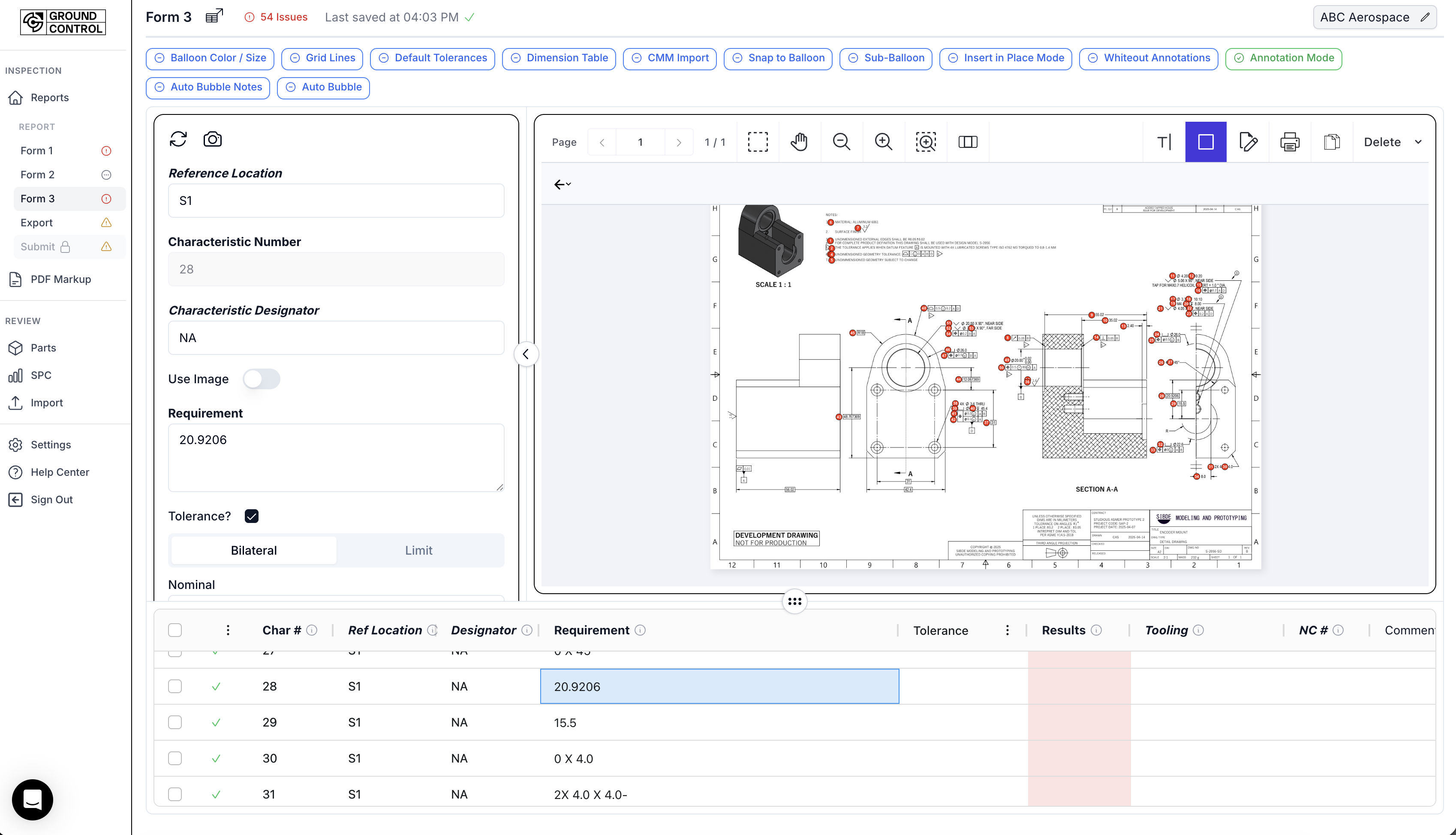
Photo: GroundControl
From First Article to Full Contract Review
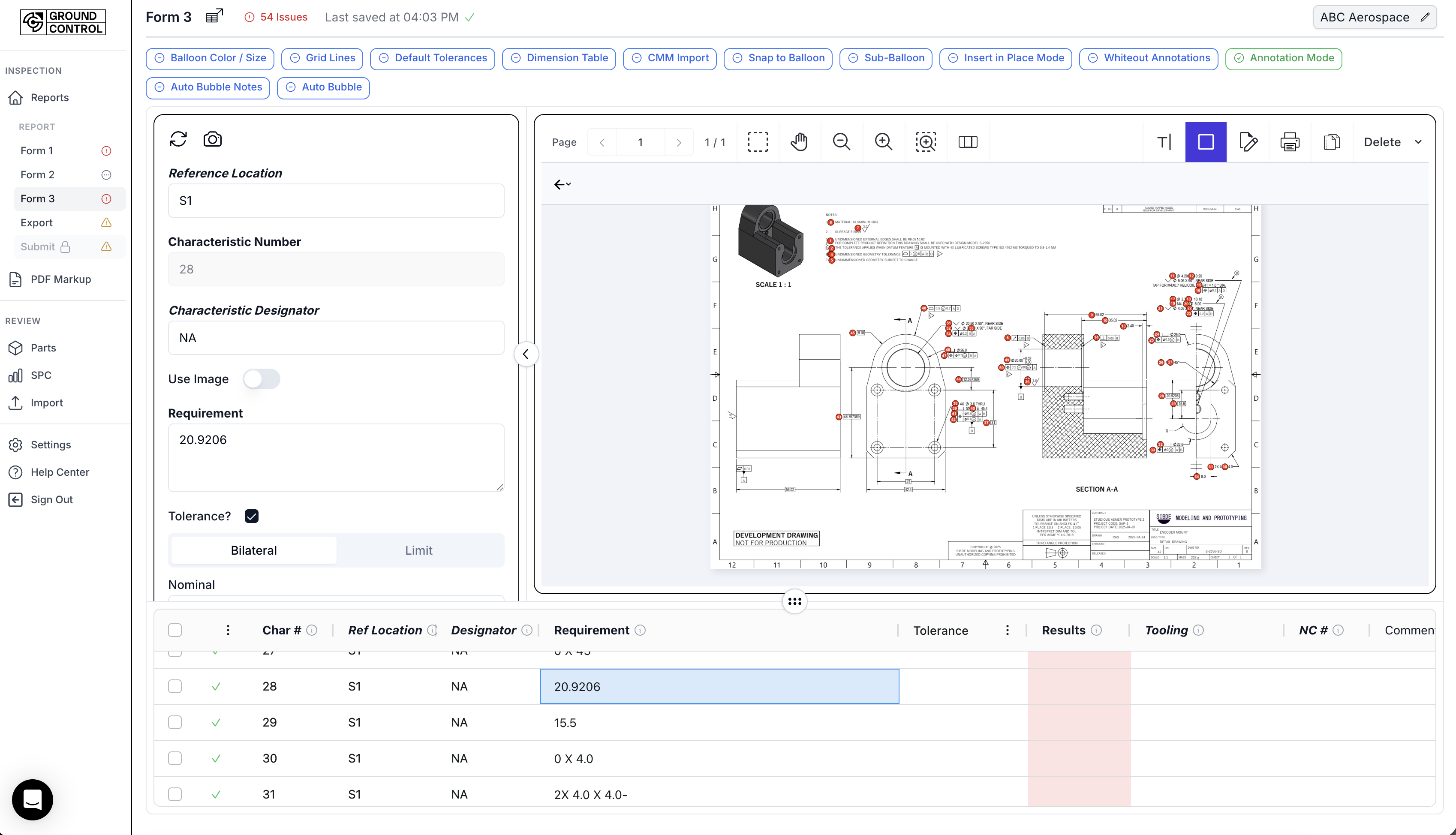
GroundControl's flagship product automates the construction of those AS9102 reports: extracting characteristics and tolerances directly from engineering drawings, importing results from coordinate measuring machines and other metrology tools, pulling data from material certifications, and assembling the finished package in a fraction of the time manual preparation takes.
The company says the platform now supports more than 70 manufacturing facilities across the US generating close to 1,000 reports monthly, with case studies pointing to dramatic throughput gains; one contract electronics manufacturer, AdvancedPCB, has publicly credited the platform with a 156% increase in FAI throughput after adoption.
The second product Nick highlighted addresses a different point in the supply chain entirely: contract review. This tool is aimed at the paperwork that precedes production, cross-referencing a purchase order against its terms and conditions and associated quality clauses to catch discrepancies before a job ever hits the shop floor. It's a preventative play rather than a documentation play, built on the idea that an error caught before production starts is far cheaper than one caught after.
GroundControl also offers tools further up the supply chain for APQP and PPAP package management, aimed at Tier 1 and Tier 2 suppliers managing multi-sample submissions across customer programs, along with a compliance-oriented visitor check-in product for facilities managing CMMC-related access control.

How AI Quietly Became the Backbone of Today’s Aviation Industry
Built for a Regulated Industry
Selling software that touches export-controlled technical data and Controlled Unclassified Information (CUI) comes with its own compliance burden, and GroundControl has spent much of the past year building toward it. The company is ITAR-registered and NIST SP 800-171 compliant, hosts all data in AWS GovCloud with US-only residency, and is registered under Canada's Controlled Goods Program to support customers north of the border. Most recently, Warren said, the company completed its FedRAMP Moderate Equivalency certification within the past month, closing out a process it had been working through for much of the year. "It's a very important industry to take security super, super seriously," he said, adding that the credentialing work was a "big focus from day one" rather than something bolted on after the fact.
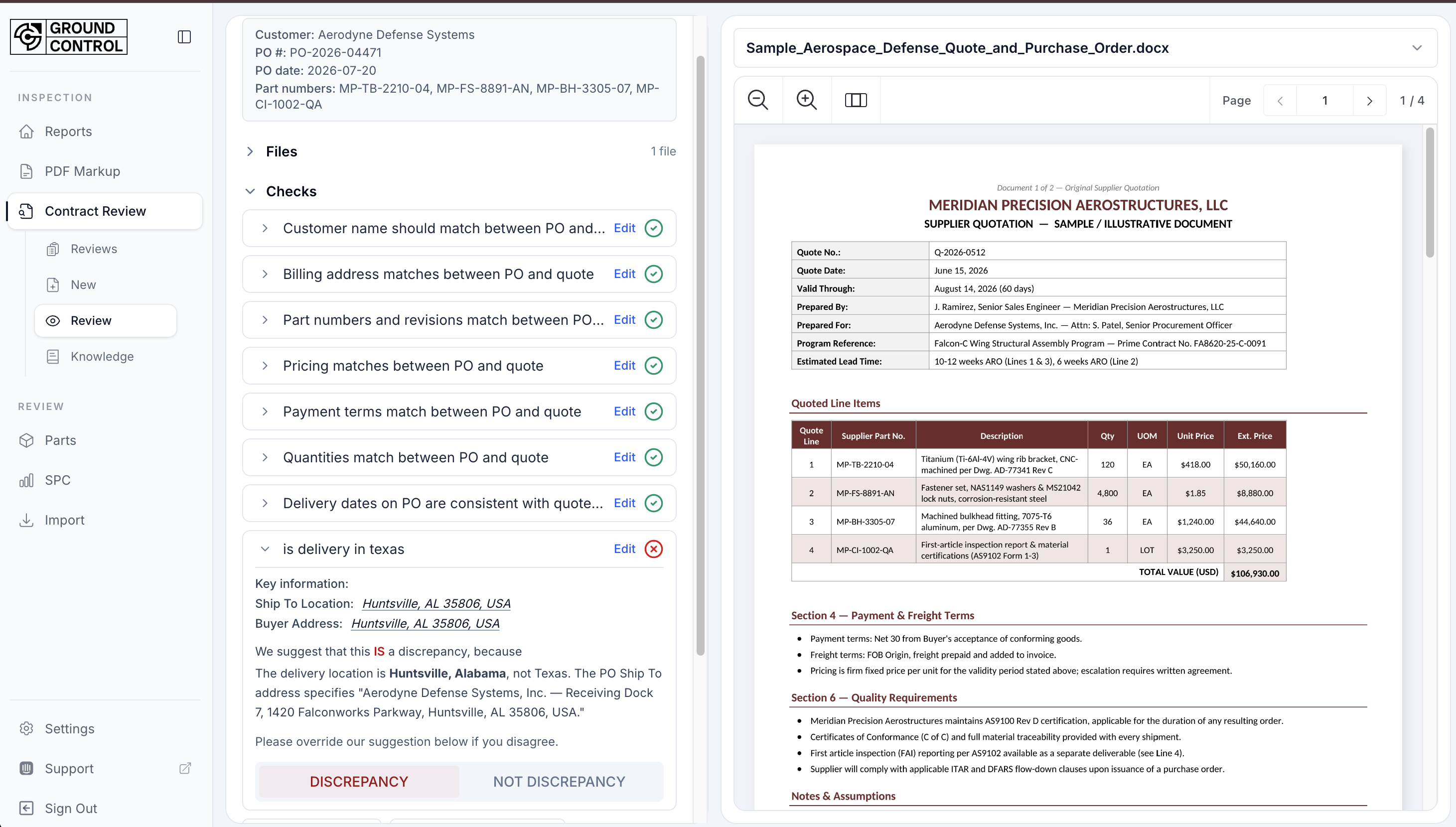
Photo: GroundControl
A Moving Regulatory Target
That security posture landed GroundControl in the middle of one of the defense industrial base's biggest stories of the summer. On July 13, just over a week before the show opened, the Department of Defense suspended Phase 2 of the Cybersecurity Maturity Model Certification (CMMC) program, the requirement that would have forced roughly 80,000 to 100,000 contractors handling CUI to obtain third-party assessments starting this November. DoD Chief Information Officer Kirsten Davies framed the move as the start of a 60-day "top-to-bottom" review of the program, driven partly by simple math: more than 100,000 companies were facing a certification deadline, and only around 100 accredited third-party assessors existed to certify them.
Asked about it on the show floor, Warren treated the news less as a threat to the business than as evidence of how quickly the ground can shift underneath it. He shared, "It's definitely a changing landscape. I don't view AI changing as a challenge. I view that as exciting."
The suspension is narrower than headlines might suggest: Phase 1 self-assessment requirements, which became mandatory last November, remain fully in force, as do the underlying NIST SP 800-171 safeguarding obligations and the Department of Justice's willingness to pursue False Claims Act cases against contractors whose compliance representations don't hold up. What's paused is specifically the mandatory third-party certification layer, meaning the documentation and self-assessment work GroundControl's tools support doesn't go away, even as the certification mechanism sitting on top of it gets rebuilt.
Meeting Manufacturers Where They Are
A recurring theme in GroundControl's pitch is that compliance software has historically been built for the people who read the reports, not the people who generate them. Warren pointed to onboarding and support as a deliberate differentiator: every customer gets personalized onboarding plus follow-up support, backed by a customer success team, with the explicit goal of making the software usable for a shop-floor quality inspector, not just the quality manager evaluating ROI on a spreadsheet.
On the product side, that translates into AI features aimed squarely at the tedious parts of the job: automatic drawing ballooning, extraction from material certifications, and direct CMM data import, each designed to remove a specific manual step rather than replace the inspector's judgment.
With regard to the software’s backend, Nick described it as a mixed approach: some models trained in-house by GroundControl's own R&D team, and others hosted off-the-shelf within AWS GovCloud, deployed depending on the use case. It's a pragmatic answer from a company whose customers operate in an industry where "we used the biggest model available" is rarely the right answer; cost, data residency, and auditability tend to matter as much as raw capability.
Looking Ahead
GroundControl's pitch doesn't rest on a single breakthrough technology so much as a bet that the unglamorous, paperwork-heavy corner of aerospace manufacturing has been underserved by software for long enough that meaningful gains are still available to whoever automates it well.
The company's own numbers suggest it's early in that process. But with fresh certifications in hand and a regulatory landscape that just handed compliance software an unexpected new wrinkle to solve, GroundControl heads out of Farnborough with a case that's easy enough for even a non-engineer to follow: the part was never the hard part. The paperwork was.
More information on GroundControl's product range is available at gndctl.com.
IATA's New Passenger Data Shows Global Air Travel Demand Shrinking for the First Time This Year » Caribbean Airlines Expands Network With New Toronto and Caracas Routes » AirBaltic to Cut Up to 700 Jobs in Restructuring »

Comments (0)
Add Your Comment
TAGS
NEWS GroundControl Aerospace Manufacturing Compliance Software Artificial Intelligence AS9102 Quality Assurance Defense Contracting CMMC Y Combinator Farnborough AirshowRECENTLY PUBLISHED
 KLM Brings Starlink Internet to Long-Haul Flights
KLM Royal Dutch Airlines will roll out free high-speed Starlink Wi-Fi on long-haul flights starting in 2027, but short-haul routes miss out.
NEWS
READ MORE »
KLM Brings Starlink Internet to Long-Haul Flights
KLM Royal Dutch Airlines will roll out free high-speed Starlink Wi-Fi on long-haul flights starting in 2027, but short-haul routes miss out.
NEWS
READ MORE »
 US State Department Warns of Threats to Airlines and Airports in Saudi Arabia Following Deadly Houthi Attacks
The US State Department has issued a security alert for Saudi Arabia after Houthi air attacks on the kingdom killed three people and injured dozens more.
NEWS
READ MORE »
US State Department Warns of Threats to Airlines and Airports in Saudi Arabia Following Deadly Houthi Attacks
The US State Department has issued a security alert for Saudi Arabia after Houthi air attacks on the kingdom killed three people and injured dozens more.
NEWS
READ MORE »
 Southwest Airlines Becomes First US Carrier to Integrate Flight Booking Into ChatGPT
Southwest Airlines launches a first-of-its-kind ChatGPT plugin, allowing travelers to search and book flights directly through the AI platform.
NEWS
READ MORE »
Southwest Airlines Becomes First US Carrier to Integrate Flight Booking Into ChatGPT
Southwest Airlines launches a first-of-its-kind ChatGPT plugin, allowing travelers to search and book flights directly through the AI platform.
NEWS
READ MORE »
More than just headlines.
Get unlimited ad-free access to in-depth aviation news, premium stories, and exclusive insights other sites don't cover.
- Ad-free browsing on AeroXplorer
- Unlimited access to premium and exclusive articles
- Higher photo upload limits & commissions on sales
- Free access to Jetstream Magazine on higher tiers
- Ad-free browsing
- Sell aviation photos with 60% commission
- First week free!
- Everything in Basic+
- Unlimited premium articles
- Sell aviation photos with 70% commission
- Free Digital subscription to Jetstream Magazine
- First week free!
- Everything in Basic+ and Pro
- Sell aviaiton photos with 80% commission
- Early access to exclusive stories
- Free Digital+Print subscription to Jetstream Magazine