

Originally published in Jetstream Magazine by Ejaaz Cadinouche.
Imagine stepping out of your office, walking to a nearby rooftop, and moments later lifting off vertically into the sky — no airport lines, no traffic, just a silent hop across the city. This future is no longer science fiction; it's the foundation of what could be aviation's biggest innovation since the jet age.
The aviation industry is constantly looking for new ways to decrease its carbon footprint. Significant investments in time, money, and research have been made to advance aerospace into a new era of more efficient, greener operations. One of these major investments is being made in electric vertical takeoff and landing technologies, or eVTOL.

Advanced Air Mobility (AAM), Urban Air Mobility (UAM), and Regional Air Mobility (RAM) have been the main focus of late, with the Federal Aviation Administration (FAA) meeting to formulate new pilot certificates and training and assessment standards. These would facilitate the operation of eVTOL aircraft in the National Airspace System in the United States.
Initial Goals
Preliminary ideas have put a spotlight on the "air taxi" concept, with "vertiports" being strategically placed in cities to allow travelers to transfer between commercial flights. With the ultimate goal being a type of "Uber of the Skies," the first step will primarily allow business travelers to reach their meetings and engagements within a metropolis.

For RAM, the FAA would like most of its focus channeled into spearheading regional travel in the eVTOL realm. Air taxis would certainly unlock a new era of convenience. However, more work must be done in order to cement the public and industry confidence in the safety of operations. Incorporating eVTOLs into low-altitude urban airspace – while avoiding transition zones and considering the aerodynamics of rotorcraft in dense environments – will be challenging but achievable.
RAM will allow passengers to travel short distances – approximately 100 nautical miles (115 miles) – between cities. While these aircraft will initially be crewed, the ultimate goal is a completely autonomous operation. Although the technology for autonomous vehicles does exist, the overarching challenge will be to convince the general public of its level of safety and accuracy.
Aside: As a pilot myself, there is a certain level of autonomy that I can put my trust in. Exceeding that level starts to increase levels of apprehension due to a perceived drop in control over the aircraft’s operation.
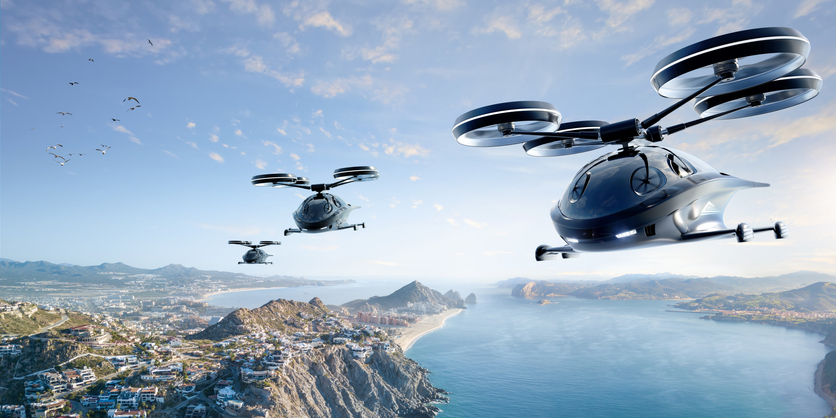
Having a pilot oversee the aircraft as it flies itself — with an option to immediately and seamlessly take control — looks to be the most likely course of action. This way, passengers and the public still have the confidence that a highly-trained professional is able to take manual control in the event of any malfunction or emergency.
Who are the Major Players?
The major stakeholders in UAM and RAM will ultimately put their trust in a company that can build a safe and reliable aircraft in a timely manner. Whoever wins the race wins the contract.
As of November 2025, the top names in eVTOL aircraft include companies such as Joby Aviation, Archer Aviation, and Wisk. Archer Aviation already saw its ACHR28 eVTOL successfully complete a test flight over Abu Dhabi earlier this year. Even established players have begun to put their trust in the industry — United Airlines, for one, recently invested $10 million in Archer.
Current differences in philosophies and technologies seem to be the reasons for an abundance of companies pursuing a stake in perhaps the most innovative turning point in the aviation industry. Right now, there is a fair amount of freedom in terms of design and development. The challenge will lie in successfully incorporating novel designs into an aged system.
What Does the Technology Look Like?
Many questions are being asked regarding how pilots will be certified to fly these aircraft. The certification will depend on the technology used.
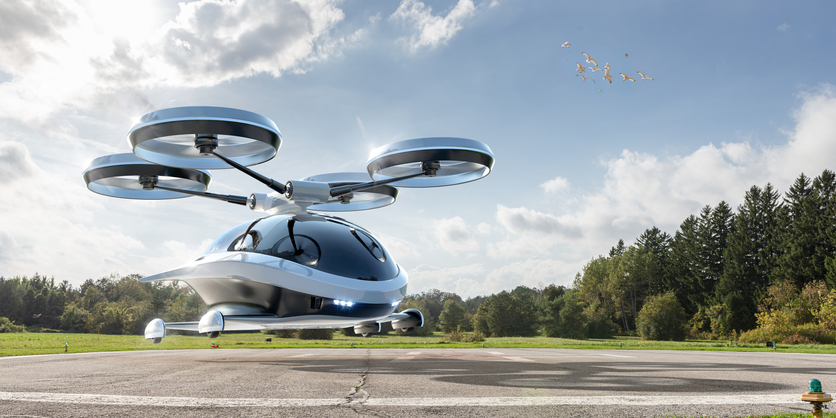
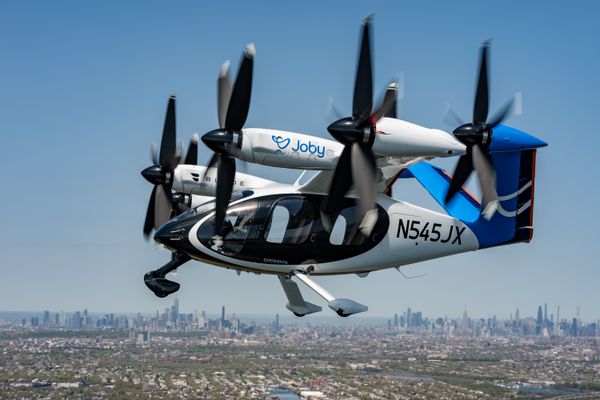
Most new eVTOL concepts adopt a multicopter design, with multiple arms extending to house the motors and propellers. These propellers are then able to move, providing vectored thrust: thrust that can be delivered at varying angles. Tilt-wing configurations, which can rotate the entire arm or wing, also enable the angle of the thrust output to be changed. Initial designs for these multicopter eVTOL aircraft look very similar to powered-lift aircraft types such as the Bell Boeing V-22 Osprey. What's more, powered-lift is already a category within aircraft and airman certification in the FAA. On this aircraft, the massive propellers work just like the tilt-wing configurations: they point upwards during takeoff and landing, and rotate up to 90 degrees to facilitate high-speed forward flight. Since this is already a proven technology, it appears – on the surface, at least – that FAA certification should be a smoother process than may have been initially posited.
Batteries are the main source of power for these aircraft, but they will always pose some issues. Firstly, low specific power — specific power being a measure of electric efficiency — means a potential lack of sufficient range. Batteries also tend to be heavy by design, requiring more power output to lift the aircraft during takeoff and landing, and a higher cruising speed to maintain altitude.

There are hydrogen fuel cell designs in the works; however, these designs do not possess the energy and power required for an entire flight. Manufacturers are researching hybrid designs, where electrical power is used for power-intensive flight stages like takeoff and landing, and hydrogen power is used for cruise flight, where lower energy levels are required. This would lower the overall weight and preserve battery energy to maximize range.
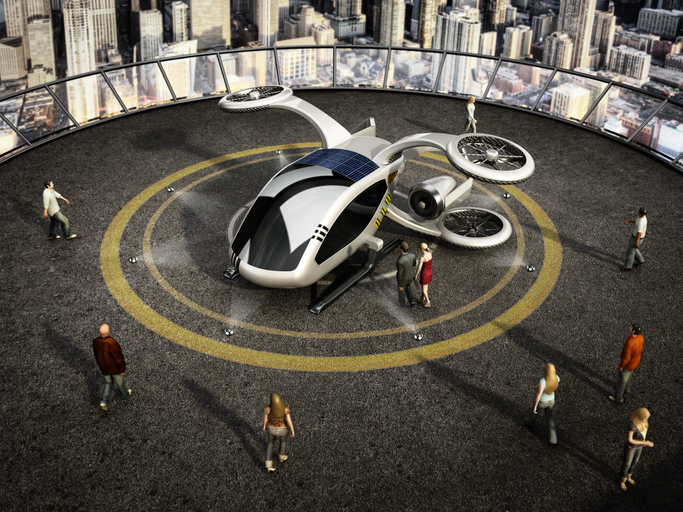
The aircraft will use vertiports, similar to helipads, to transport passengers to and from destinations. While helipads are very small facilities without a dedicated terminal or services, a vertiport will incorporate the more traditional setting of an airport. Right now, suitable locations seem to be the very top floor of parking garages, which mimic or simulate the vertiports that will be in use. Imagine numerous small helipads grouped together at a safe distance from each other on the same surface to allow multiple eVTOL aircraft to board and park at the same time. There are even startup companies that have designed a modular solution to vertiports that can be very easily installed atop a large building or, again, even a parking garage. These will come equipped with a small FBO-style terminal connected to them.
Is There a Timeline?
Currently, the United States is the only country with a firm plan to implement eVTOL technology into the National Airspace System. In July 2023, the FAA created an implementation plan to have the technology in use by 2028.
AAM, UAM, and RAM fall under 14 Code of Federal Regulations Part 135, which mainly governs unscheduled, on-demand air operators such as air charter services. Since there are already regulations in place for these desired operations, it will likely be easier for eVTOL companies to firmly incorporate air taxi and AAM services into daily flights.
Surely there's a Cost?
As with everything in aviation, there is no such thing as a free lunch. This is especially true when it comes to aerospace.
Unit costs are projected to be in the hundreds of thousands of US dollars for two-seater types and even into the millions for larger commercial types. A Chinese eVTOL developer estimated two-seat unit costs at around $970,000. Archer Aviation quotes around the $5 million mark.
At the moment, ticket costs are projected to be quite high, given that it is a new technology and market. The cost per passenger mile could be as high as $11 starting out. For reference, a Boeing 737 costs around $0.10 per passenger per mile. The Boeing 787 Dreamliner costs around $0.12 per passenger per mile. This also would depend on the type of eVTOL aircraft being used. Initial projections see a 100-mile flight costing just north of $200 one-way.
While companies estimate a high operating cost to begin with, which means expensive tickets for passengers, long-term costs are expected to decrease as the market expands and operations ramp up.
In Conclusion
AAM and eVTOL technology blends cutting-edge innovation with current technology to create an era of flying that resembles scenes from a 1990s sci-fi movie. With just a few more years of research and development, those movie scenes seem to be coming to life. There are many major stakeholders and potential investors in the eVTOL realm looking to take advantage of this new age of flying that hopes to not only make the world smaller but also more accessible to all.
American Airlines Swaps Landline Buses for CRJ-700 Flights on 84-Mile South Bend to Chicago Route » Alaska Airlines Sets Sights on Final Major U.S. Carrier Takeover While Building Global Seattle Hub » Embraer Posts Record 66 Aircraft Deliveries in Q3 2026 as Commercial Jets Climb 10% »

Comments (0)
Add Your Comment
TAGS
INFORMATIONAL eVTOL Flight Electric Travel FuturisticRECENTLY PUBLISHED
 US State Department Warns of Threats to Airlines and Airports in Saudi Arabia Following Deadly Houthi Attacks
The US State Department has issued a security alert for Saudi Arabia after Houthi air attacks on the kingdom killed three people and injured dozens more.
NEWS
READ MORE »
US State Department Warns of Threats to Airlines and Airports in Saudi Arabia Following Deadly Houthi Attacks
The US State Department has issued a security alert for Saudi Arabia after Houthi air attacks on the kingdom killed three people and injured dozens more.
NEWS
READ MORE »
 Southwest Airlines Becomes First US Carrier to Integrate Flight Booking Into ChatGPT
Southwest Airlines launches a first-of-its-kind ChatGPT plugin, allowing travelers to search and book flights directly through the AI platform.
NEWS
READ MORE »
Southwest Airlines Becomes First US Carrier to Integrate Flight Booking Into ChatGPT
Southwest Airlines launches a first-of-its-kind ChatGPT plugin, allowing travelers to search and book flights directly through the AI platform.
NEWS
READ MORE »
 Joby Aviation to Pay $116.9 Million in Trade Secrets Case
A federal jury found air taxi maker Joby Aviation liable for misappropriating trade secrets, awarding $116.9 million in damages to the plaintiff.
NEWS
READ MORE »
Joby Aviation to Pay $116.9 Million in Trade Secrets Case
A federal jury found air taxi maker Joby Aviation liable for misappropriating trade secrets, awarding $116.9 million in damages to the plaintiff.
NEWS
READ MORE »
More than just headlines.
Get unlimited ad-free access to in-depth aviation news, premium stories, and exclusive insights other sites don't cover.
- Ad-free browsing on AeroXplorer
- Unlimited access to premium and exclusive articles
- Higher photo upload limits & commissions on sales
- Free access to Jetstream Magazine on higher tiers
- Ad-free browsing
- Sell aviation photos with 60% commission
- First week free!
- Everything in Basic+
- Unlimited premium articles
- Sell aviation photos with 70% commission
- Free Digital subscription to Jetstream Magazine
- First week free!
- Everything in Basic+ and Pro
- Sell aviaiton photos with 80% commission
- Early access to exclusive stories
- Free Digital+Print subscription to Jetstream Magazine