


Airlines built entire operations around managing uncertainty, whether it be weather delays, mechanical checks, crew scheduling, or even the occasional disruptive passenger. All of it gets planned for.
But a passenger’s heart, lungs, or blood sugar failing at 38,000 feet, on the other hand, does not. Worst of all, these incidents often occur hours from the nearest runway, inside a cabin staffed by people trained for meal service and evacuation drills, not medical procedures.
For decades, the industry’s response to that gap has stayed fairly static, consisting of a first aid kit, a scripted call to a ground-based advisory line, and the infamous phrase made over the aircraft’s PA system: “Is there a doctor onboard?”
What if the crew simply had a real emergency physician available, live, the moment something goes wrong?
Enter Skali, a Silicon Valley venture-backed startup working to solve that very problem.
The Call That Changes Everything
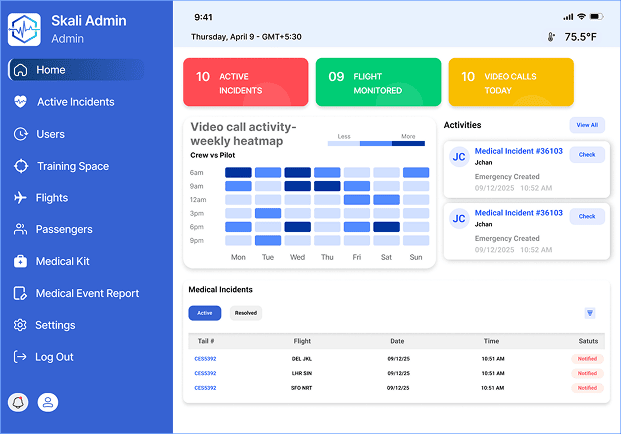
When a medical episode unfolds mid-flight, a crew member activates the Skali software on a phone, tablet, or laptop already onboard. Within 90 seconds, they’re connected to a board-certified emergency physician over live radio.
The physician can see everything that the crew sees. They guide a physical assessment, interpret whatever vitals are available, and issue clear direction: what to administer, what to monitor, and what would genuinely warrant an immediate diversion.

The diversion assessment carries real financial weight for an airline. Early landings can cost airlines tens of thousands of dollars and disrupt schedules for days afterward. A confident physician on the other end of a video call, at the right moment, has proven capable of turning a would-be emergency landing into a manageable in-flight event.
During a recent flight aboard a private family office jet, a passenger fell ill mid-flight. The crew activated Skali's EMaaS platform and connected with a board-certified emergency medicine physician in real time. Within minutes, the physician remotely assessed the passenger, guided the crew through an onboard evaluation, and confirmed the passenger was stable to continue to the destination.
The diversion was avoided, saving the operator tens of thousands of dollars in unplanned fees and disruption, while ensuring the passenger received expert medical care at 36,000 feet.

Analysis: How Spirit Airlines Changed Airline Pricing, then Paid the Price
Built for Aviation
Cruising altitude is a famously hostile place for connectivity. Hundreds of passengers seek to join a single broadband connection, causing slow connectivity speeds and frequent drop-offs. What’s worse, airlines often experience WiFi malfunctions, leaving passengers without a connection at all. But Skali was engineered specifically for that constraint, holding a stable connection with HD video and live data sharing, even over thin satellite links.
"I got a call in the middle of the night from a customer — they wanted me to know that their crew had just spoken with one of our physicians in real time, mid-flight. That call told me everything about why we built Skali."
— Husein Attarwala, Co-Founder & CEO, Skali Inc.
Connectivity was never an afterthought at Skali — it was a foundational design requirement. The platform is engineered to operate on standard onboard WiFi at less than 8Mbps, meaning crews can reach a board-certified emergency medicine physician in real time without relying on specialized satellite equipment or high-bandwidth connections. In an industry where connectivity is often cited as a barrier to telemedicine adoption, Skali deliberately built around the infrastructure operators already have.
The platform runs on whatever device is already onboard, whether it be a smartphone, tablet, or laptop. No proprietary hardware installation is needed, and every consultation carries HIPAA-compliant encryption. This gives mid-air medical events the same privacy standards as an appointment in a doctor’s office on the ground.
A Widely-Ranging Target Market
A Falcon 7X crossing the ocean with a handful of passengers and a 787 carrying hundreds face very different logistics. However, they have the same vulnerability: limited medical training onboard, and long stretches with no ground support nearby can lead to dangerous circumstances in the case of a medical emergency.
Skali closes that distance for both. A private cabin gets a physician within a minute and a half of activation. A commercial flight crew gets the clinical backup to weigh a diversion against continued monitoring, grounded in expert input rather than guesswork. Even a two- or three-person cargo crew, hours from any airport, gets the same 90-second connection guarantee.
"This is a quantum leap from what is current practice in the industry."
— Captain Colin, Airline Captain
Skali recently signed channel partnerships with CAPS Aviation and LD Aviation, who put it plainly:
“Companies like LD Aviation have found that clients integrating Skali gain a significant safety and client management advantage. By pairing Skali's emergency physician access with LD Aviation's dispatch expertise, these clients eliminate costly diversions and create competitive differentiation.”

The Real Win
Skali’s website sums up its purpose in a single recorded outcome: a case managed, a diversion avoided. That single line represents the platform's actual ambition: ensuring that hundreds of ordinary flights land on schedule because a physician is reachable at the exact moment that a crew needs one.
A diverted flight can cascade into missed connections, disrupted crews, and six-figure costs. Skali’s aim is to minimize this domino effect by making it rarer, putting expert medical judgement within 90 seconds of anyone, anywhere in the sky.
For those visiting NBAA-BACE this year, stop by booth to learn more about Skali, or visit www.skalillc.com
How a Tennis Court Invention Became a Critical Airfield Safety Tool » Alaska Air Group Faces $521,000 Lawsuit After Rain Ruins 11 Japanese Artworks in Checked Luggage » JetBlue Expands Fort Lauderdale Footprint With Eight New Nonstop Routes and Six More on the Way »

Comments (0)
Add Your Comment
TAGS
STORIES SKALI Jetstream Magazine Medical Telemedicine Aviation Doctor Travel DoctorRECENTLY PUBLISHED
 Emirates Wins Approval for Direct Berlin Flights After 22-Year Push
Emirates has secured approval to launch direct flights between Dubai and Berlin, ending a lobbying effort that stretched more than two decades.
ROUTES
READ MORE »
Emirates Wins Approval for Direct Berlin Flights After 22-Year Push
Emirates has secured approval to launch direct flights between Dubai and Berlin, ending a lobbying effort that stretched more than two decades.
ROUTES
READ MORE »
 25 Years After 9/11: How Airline Security Transformed and What Is Changing Once Again
A quarter century after the September 11 attacks, airline security has evolved dramatically. Here is what changed and what is shifting now.
NEWS
READ MORE »
25 Years After 9/11: How Airline Security Transformed and What Is Changing Once Again
A quarter century after the September 11 attacks, airline security has evolved dramatically. Here is what changed and what is shifting now.
NEWS
READ MORE »
 United Airlines Boeing 777 Diverts to Bangor After Intoxicated Passenger Bites Flight Attendant
A United Airlines flight from Tel Aviv to Newark diverted to Bangor, Maine after an intoxicated first class passenger bit a flight attendant.
NEWS
READ MORE »
United Airlines Boeing 777 Diverts to Bangor After Intoxicated Passenger Bites Flight Attendant
A United Airlines flight from Tel Aviv to Newark diverted to Bangor, Maine after an intoxicated first class passenger bit a flight attendant.
NEWS
READ MORE »
More than just headlines.
Get unlimited ad-free access to in-depth aviation news, premium stories, and exclusive insights other sites don't cover.
- Ad-free browsing on AeroXplorer
- Unlimited access to premium and exclusive articles
- Higher photo upload limits & commissions on sales
- Free access to Jetstream Magazine on higher tiers
- Ad-free browsing
- Sell aviation photos with 60% commission
- First week free!
- Everything in Basic+
- Unlimited premium articles
- Sell aviation photos with 70% commission
- Free Digital subscription to Jetstream Magazine
- First week free!
- Everything in Basic+ and Pro
- Sell aviaiton photos with 80% commission
- Early access to exclusive stories
- Free Digital+Print subscription to Jetstream Magazine