
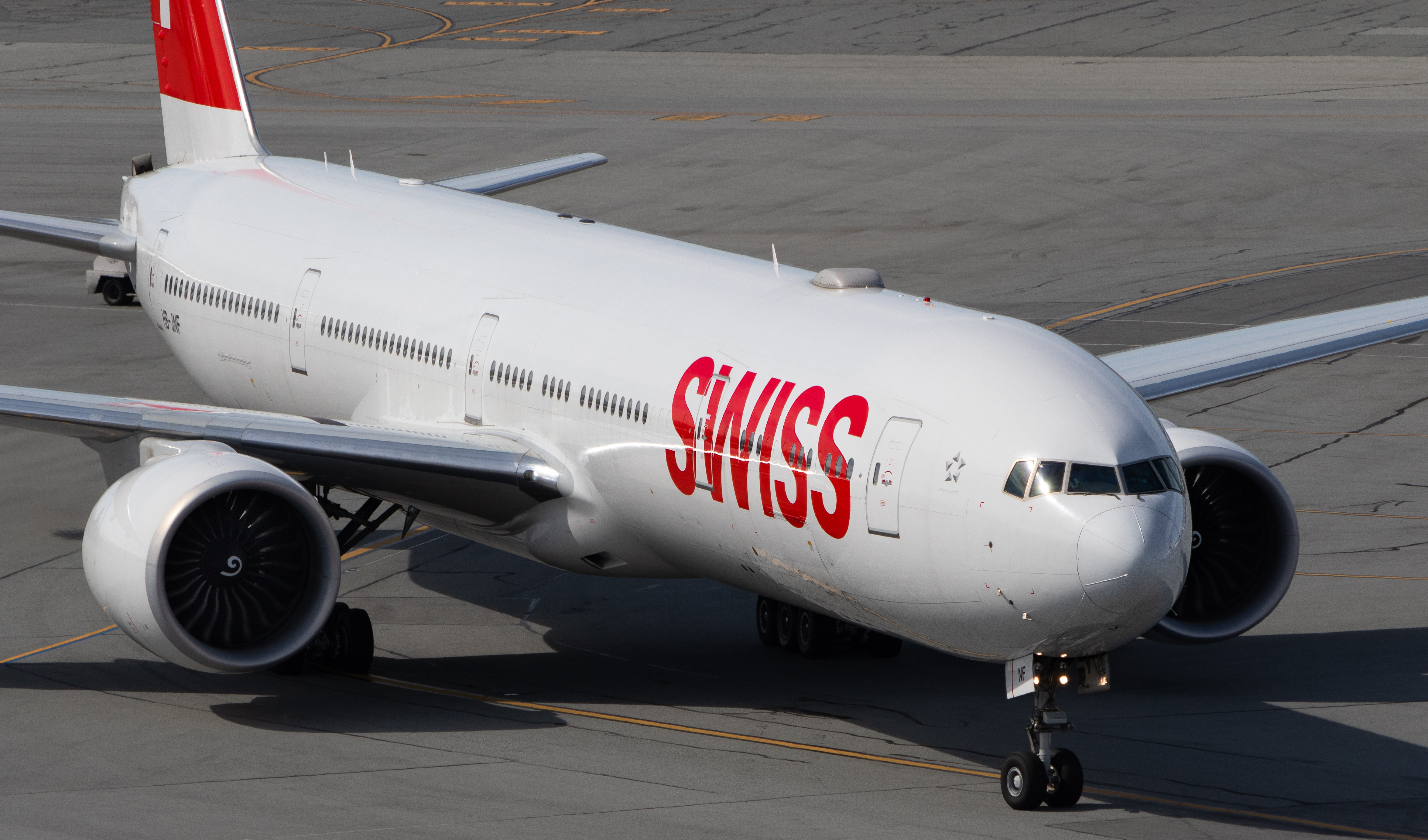

A Swiss International Air Lines Boeing 777-300ER operating a transatlantic service to Miami diverted to Lajes Airport in the Azores this week after the crew reported an unidentified odor inside the cabin. The incident prompted the flight deck to declare an emergency and execute an unscheduled landing at the Portuguese island airfield.
The aircraft, registered HB-JNF, was operating flight LX64 from Zurich to Miami International Airport when the crew detected the smell and elected to divert. According to tracking data, the widebody had already crossed a significant portion of the North Atlantic before turning south toward Terceira Island, home to Lajes Field, a joint civil-military facility frequently used as a contingency airport for transatlantic operations.
Emergency Declaration and Diversion
The flight crew declared a general emergency by squawking 7700, the international transponder code indicating an aircraft in distress. This declaration granted the flight priority handling from air traffic controllers and mobilized emergency response services at the destination airport.
The Boeing 777-300ER landed safely at Lajes without further incident. All passengers and crew disembarked normally, and no injuries were reported in connection with the event. Emergency crews met the aircraft on arrival as a standard precaution following the declaration.
Lajes Airport, located roughly 1,500 kilometers west of mainland Portugal, serves as a critical alternate for aircraft operating North Atlantic tracks. Its runway length and infrastructure make it capable of accommodating widebody aircraft such as the 777-300ER, which is among the largest twin-engine airliners in commercial service.

Cabin Odor Events in Commercial Aviation
Unidentified odors on commercial flights represent a recognized category of in-flight abnormality that airline crews are trained to address with caution. Such events can originate from multiple sources, including bleed air contamination from the engines or auxiliary power unit, electrical component overheating, galley equipment malfunctions, or cargo-related issues.
Fume events, in which oil or hydraulic fluid vapors enter the cabin through the environmental control system, have drawn increased scrutiny from regulators and industry groups in recent years. The Boeing 777, like most modern airliners, relies on engine bleed air routed through air conditioning packs to pressurize and ventilate the cabin. When seals degrade or components fail, contaminants can enter the airflow.
Standard operating procedures typically require flight crews to put on oxygen masks, isolate affected air conditioning systems where possible, and consider diverting to the nearest suitable airport. The decision to divert rather than continue reflects the conservative approach that both regulators and manufacturers recommend when the source of an odor cannot be quickly identified.

How AI Quietly Became the Backbone of Today’s Aviation Industry
The Aircraft and Route
SWISS operates a fleet of Boeing 777-300ERs primarily on long-haul routes from its Zurich hub to destinations in North America, Asia, and Latin America. The type serves as the flag carrier's largest passenger aircraft, typically configured with First, Business, Premium Economy, and Economy cabins.
The Zurich to Miami route is a daily transatlantic service that ordinarily takes approximately 10 hours to complete. Diverting to the Azores added significant complexity for both the airline and its passengers, given the limited onward connection options from Terceira.
SWISS, part of the Lufthansa Group, has faced heightened operational scrutiny of its long-haul fleet in recent months. The carrier has been managing capacity challenges related to engine availability on its Airbus A220 narrowbody aircraft, though those issues are unrelated to the 777 fleet.

Passenger Handling and Recovery
Following the diversion, SWISS was tasked with arranging accommodation and onward transportation for affected passengers from a remote island location. Lajes Airport handles limited scheduled commercial traffic, which complicates recovery operations when unplanned widebody diversions occur.
The airline has not publicly confirmed the source of the odor as of this reporting. Maintenance teams typically conduct extensive inspections following such events, examining the environmental control system, engine bleed air components, avionics bays, and galley equipment. The aircraft usually remains on the ground until technicians identify and address the cause.
For a widebody such as the 777-300ER, ferrying the aircraft back to a main maintenance base may require specialized approvals depending on the outcome of initial inspections. If maintenance personnel cannot resolve the issue at Lajes, SWISS may need to dispatch technicians and parts to the island.
Regulatory Context
The European Union Aviation Safety Agency and the United States Federal Aviation Administration both maintain reporting requirements for cabin air quality events. Operators must document such occurrences and share relevant data with regulators, which contributes to broader safety monitoring across the industry.
Boeing and engine manufacturers have introduced design refinements over successive product generations aimed at reducing the frequency of bleed air contamination events. The 787 Dreamliner notably departs from traditional architecture by using electrically driven compressors rather than engine bleed air for cabin pressurization, though the 777 family retains the conventional bleed-air approach.
SWISS has not yet issued a detailed public statement identifying the cause of the odor. The airline typically reserves technical findings until internal investigations conclude, in coordination with the aircraft manufacturer and relevant regulatory authorities.
The incident underscores the operational value of North Atlantic alternates such as Lajes, Keflavik, Shannon, and Gander, which continue to play essential roles in supporting long-haul flight safety across one of the world's busiest oceanic corridors.
British Airways Flight to Chicago Forces Emergency Descent After Cabin Pressure Failure » 4th vs 5th Generation Fighter Jets: How Fighter Jets Have Evolved » AirBaltic to Cut Up to 700 Jobs in Restructuring »

Comments (0)
Add Your Comment
TAGS
NEWS SWISS International Air Lines Boeing 777 Azores Diversion Cabin Odor In-Flight Emergency Lajes Airport Chicago to Zurich Aviation SafetyRECENTLY PUBLISHED
 4th vs 5th Generation Fighter Jets: How Fighter Jets Have Evolved
A look at what separates fourth- and fifth-generation fighter jets, from stealth and sensor fusion to combat capability and cost.
INFORMATIONAL
READ MORE »
4th vs 5th Generation Fighter Jets: How Fighter Jets Have Evolved
A look at what separates fourth- and fifth-generation fighter jets, from stealth and sensor fusion to combat capability and cost.
INFORMATIONAL
READ MORE »
 United 777 Diverts to Dublin After Cockpit Windscreen Cracks Over the Atlantic
A United Airlines Boeing 777 bound for Milan made a steep descent and diverted to Dublin after its cockpit windscreen cracked mid-flight.
NEWS
READ MORE »
United 777 Diverts to Dublin After Cockpit Windscreen Cracks Over the Atlantic
A United Airlines Boeing 777 bound for Milan made a steep descent and diverted to Dublin after its cockpit windscreen cracked mid-flight.
NEWS
READ MORE »
 Boeing's Touchscreen Flight Controls for 737 Draw Sharp Criticism from Pilots
Boeing's plan to introduce Touchscreen Control Display Units on the 737 has sparked backlash from pilots who warn of safety and usability concerns.
NEWS
READ MORE »
Boeing's Touchscreen Flight Controls for 737 Draw Sharp Criticism from Pilots
Boeing's plan to introduce Touchscreen Control Display Units on the 737 has sparked backlash from pilots who warn of safety and usability concerns.
NEWS
READ MORE »
More than just headlines.
Get unlimited ad-free access to in-depth aviation news, premium stories, and exclusive insights other sites don't cover.
- Ad-free browsing on AeroXplorer
- Unlimited access to premium and exclusive articles
- Higher photo upload limits & commissions on sales
- Free access to Jetstream Magazine on higher tiers
- Ad-free browsing
- Sell aviation photos with 60% commission
- First week free!
- Everything in Basic+
- Unlimited premium articles
- Sell aviation photos with 70% commission
- Free Digital subscription to Jetstream Magazine
- First week free!
- Everything in Basic+ and Pro
- Sell aviaiton photos with 80% commission
- Early access to exclusive stories
- Free Digital+Print subscription to Jetstream Magazine