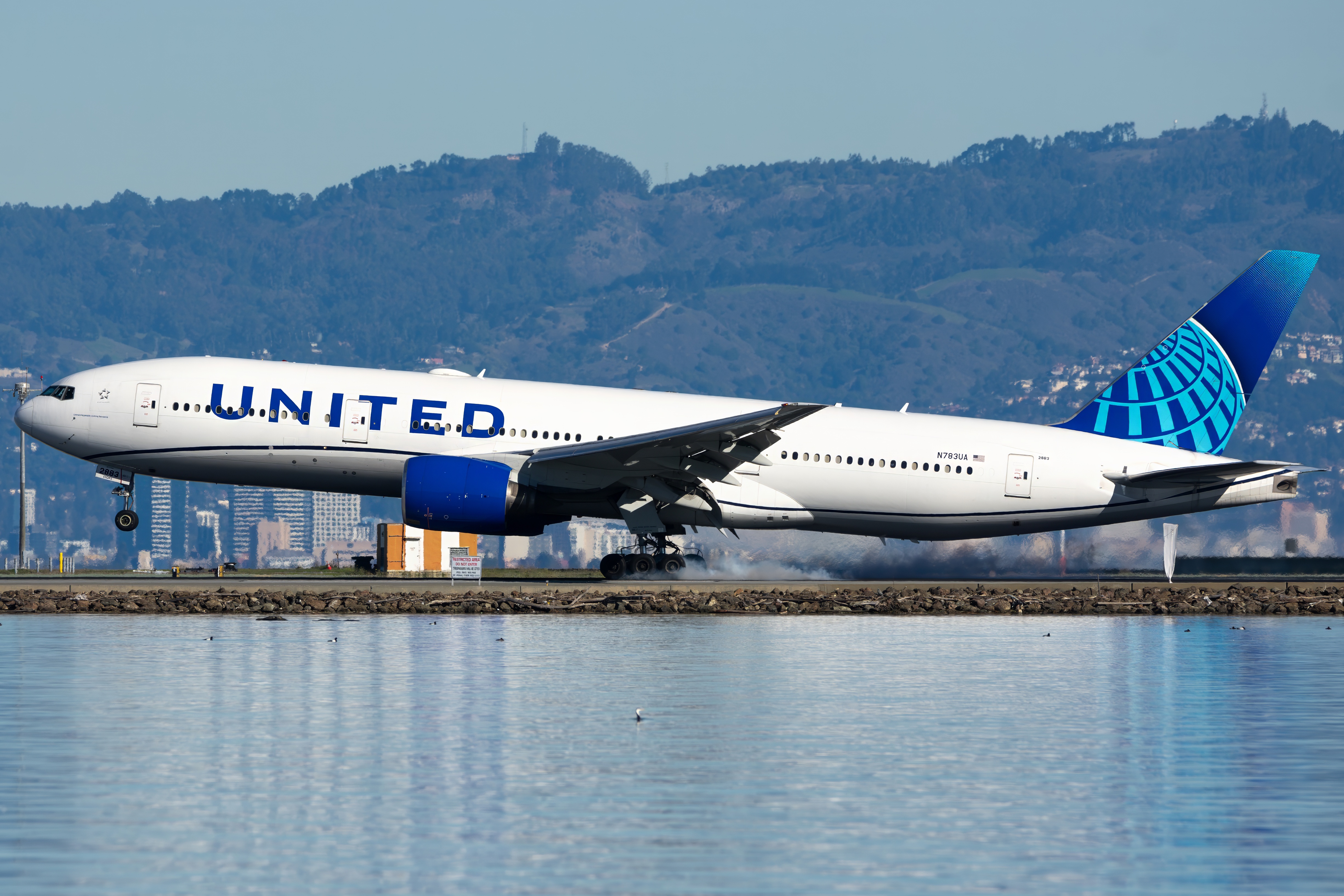

A routine transpacific journey turned into an uncomfortable test of endurance for passengers aboard United Airlines flight UA-804 on May 18, 2026, after a technical fault rendered the entire cabin entertainment infrastructure inoperable for the full duration of the flight.
United Airlines operated the 13-hour transpacific service from Tokyo Haneda Airport (HND) to Washington Dulles International Airport (IAD) without any in-flight entertainment, Wi-Fi, or in-seat power. The aircraft, a 27-year-old Boeing 777-200, developed a technical fault before departure that engineers in Tokyo could not repair.
One passenger broke the news on Reddit shortly before takeoff, writing: "They just made an announcement – no IFE, no WiFi, and no in-seat power!" The same traveller added: "13 hours just gonna zip right by after all my personal devices die." A second Redditor, posting in the r/unitedairlines community, offered a wry tribute to fellow passengers aboard the stricken service with the thread title: "Pouring one out for my fellow homies on UA804."
The affected Boeing 777-200 departed Haneda at 10:14 am and continued to the United States despite the absence of in-flight entertainment, Wi-Fi, and in-seat power. The route covers approximately 10,903 kilometres (6,774 miles).

Why the Flight Still Departed
Airlines treat technical defects in two very different ways. Some issues are system-critical and must be fixed before a plane is legally allowed to fly. Everything else falls into a separate category that does not affect airworthiness. The list of components that must function for a flight to operate is known as the Minimum Equipment List, or MEL. While certain cabin items appear on the MEL, a working in-flight entertainment system and Wi-Fi connection are not among them.
Because of this, United Airlines was able to operate flight UA-804 from Japan to the United States even though the cabin systems had failed. The aircraft was still considered legal to fly. The problem was therefore treated as a service issue rather than a grounding issue. This left the airline with a difficult operational decision. A delay could have disrupted passenger connections and onward travel plans. However, operating the flight meant that passengers would face a sharply reduced onboard experience.
The technical defect appears to have disabled the in-flight entertainment system, which is likely linked to both the in-seat power supply and possibly the Wi-Fi network. When one core system fails, connected features often stop working at the same time. Engineers at an outstation typically have limited options when this occurs: the standard remediation is to shut the system down and reboot it, much like restarting a home computer. If that step fails to restore normal operation, the aircraft must be returned to the airline's maintenance hub for a proper repair.
Relevant Flight Operations Table
| Flight No. | Route | Departure Time | Arrival Time | Duration | Operating Days |
|---|---|---|---|---|---|
| UA-804 | Tokyo Haneda (HND) → Washington Dulles (IAD) | 10:14 AM JST | 15:33 EDT | ~13 hrs (incl. taxi) | Daily (Mon–Sun) |
Note: UA-804 is also marketed as a codeshare service by ANA All Nippon Airways under flight number NH7028. The flight distance is approximately 10,903 km (6,774 miles). The affected service on May 18, 2026, was operated by a 27-year-old Boeing 777-200.
The Real-World Impact on Passengers
If only entertainment had been unavailable, passengers could have used their own devices. If only Wi-Fi had failed, downloaded content could still have been used. However, when in-seat power was also unavailable, personal devices could not be kept charged throughout the 13-hour journey. For passengers who boarded expecting the full suite of onboard services: seatback screens, internet access and USB or AC charging, the announcement just before departure would have been a significant blow.
The disruption was especially difficult because the route normally demands long hours in the air. With taxiing time included at both airports, the total travel duration reached close to 13 hours. For many travellers, this would have created immediate concern. On long-haul routes between Japan and the United States, passengers often depend on onboard systems for work, communication, films, music, sleep routines, and general comfort.


Only Way Out: Private Aviation in a Region at War
Broader Context
The UA-804 incident did not occur in isolation. There have been many recent reports of Wi-Fi on long-haul United flights being unusable or nearly unusable, especially on flights over the Pacific, which use the Panasonic system. United pilots reportedly received a memo acknowledging that the long-haul satellite provider Panasonic was “basically saturated at certain times of the day, especially over the Pacific”, an acknowledgement that United's Wi-Fi doesn't work on some, or many, flights.
United operates one of the largest transpacific networks in commercial aviation, with nonstop flights linking hubs such as San Francisco, Los Angeles, and Newark to destinations including Singapore, Sydney, Hong Kong, and Seoul. Many of these services last between 12 and 17 hours, placing them among the world's longest regularly scheduled passenger flights. Those extended journeys create particularly demanding conditions for in-flight connectivity, as hundreds of passengers simultaneously try to stay online while travelling across vast oceanic regions where satellite coverage and bandwidth can become constrained.
As more travellers experience Starlink on shorter domestic and regional flights, expectations across the broader fleet are shifting quickly. Passengers who encounter fast, stable connectivity on one aircraft are often frustrated when boarding long-haul jets still equipped with older Panasonic systems that struggle with buffering, interrupted sessions, and inconsistent speeds.
United has confirmed it is rolling out Starlink across its fleet, but the transition is far from complete. United's contract with Panasonic remains in force and will continue on an indefinite basis, since there are many aircraft which won't get Starlink for some time yet, leaving a meaningful portion of its long-haul fleet dependent on ageing satellite infrastructure in the interim.
A Difficult Moment for United's Premium Ambitions
The incident arrives at a notable time for the carrier. United's chief executive has lobbied the Trump administration with the goal of acquiring rival American Airlines, with the stated intention of creating the world's most premium airline. A 13-hour flight without entertainment, connectivity, or power does not align well with that premium positioning. At the same time, United has made significant improvements to its onboard product in recent years, and technical faults of this kind can occur on any airline.
The episode underscores a growing tension in long-haul aviation: passengers increasingly regard reliable in-cabin technology not as an optional luxury but as a baseline expectation. When that expectation fails over the Pacific, one of the world's most demanding connectivity environments, the reputational consequences extend well beyond one flight.
Boeing's Touchscreen Flight Controls for 737 Draw Sharp Criticism from Pilots » Caribbean Airlines Expands Network With New Toronto and Caracas Routes » Why Airliners Pump Nitrogen Into Their Fuel Tanks »

Comments (0)
Add Your Comment
TAGS
NEWS United Airlines Boeing 777 In-Flight Entertainment Wi-Fi Transpacific Flights Tokyo Haneda Washington Dulles Passenger Experience Aviation Technology Panasonic Avionics Starlink Minimum Equipment List Long-Haul Flights UA-804 Airline OperationsRECENTLY PUBLISHED
 Boeing's Touchscreen Flight Controls for 737 Draw Sharp Criticism from Pilots
Boeing's plan to introduce Touchscreen Control Display Units on the 737 has sparked backlash from pilots who warn of safety and usability concerns.
NEWS
READ MORE »
Boeing's Touchscreen Flight Controls for 737 Draw Sharp Criticism from Pilots
Boeing's plan to introduce Touchscreen Control Display Units on the 737 has sparked backlash from pilots who warn of safety and usability concerns.
NEWS
READ MORE »
 Southwest Airlines Blames Brief System Outage for Boarding Delays and Checked Bag Disruptions
Southwest Airlines confirms a brief technology outage disrupted boarding and checked bag operations, forcing gate agents to process travelers manually.
NEWS
READ MORE »
Southwest Airlines Blames Brief System Outage for Boarding Delays and Checked Bag Disruptions
Southwest Airlines confirms a brief technology outage disrupted boarding and checked bag operations, forcing gate agents to process travelers manually.
NEWS
READ MORE »
 Southwest Airlines Considers Boeing 787 Order for Long-Haul International Expansion
Southwest Airlines is evaluating the Boeing 787 Dreamliner as it explores a shift into long-haul international flying, sources tell Reuters.
NEWS
READ MORE »
Southwest Airlines Considers Boeing 787 Order for Long-Haul International Expansion
Southwest Airlines is evaluating the Boeing 787 Dreamliner as it explores a shift into long-haul international flying, sources tell Reuters.
NEWS
READ MORE »
More than just headlines.
Get unlimited ad-free access to in-depth aviation news, premium stories, and exclusive insights other sites don't cover.
- Ad-free browsing on AeroXplorer
- Unlimited access to premium and exclusive articles
- Higher photo upload limits & commissions on sales
- Free access to Jetstream Magazine on higher tiers
- Ad-free browsing
- Sell aviation photos with 60% commission
- First week free!
- Everything in Basic+
- Unlimited premium articles
- Sell aviation photos with 70% commission
- Free Digital subscription to Jetstream Magazine
- First week free!
- Everything in Basic+ and Pro
- Sell aviaiton photos with 80% commission
- Early access to exclusive stories
- Free Digital+Print subscription to Jetstream Magazine