
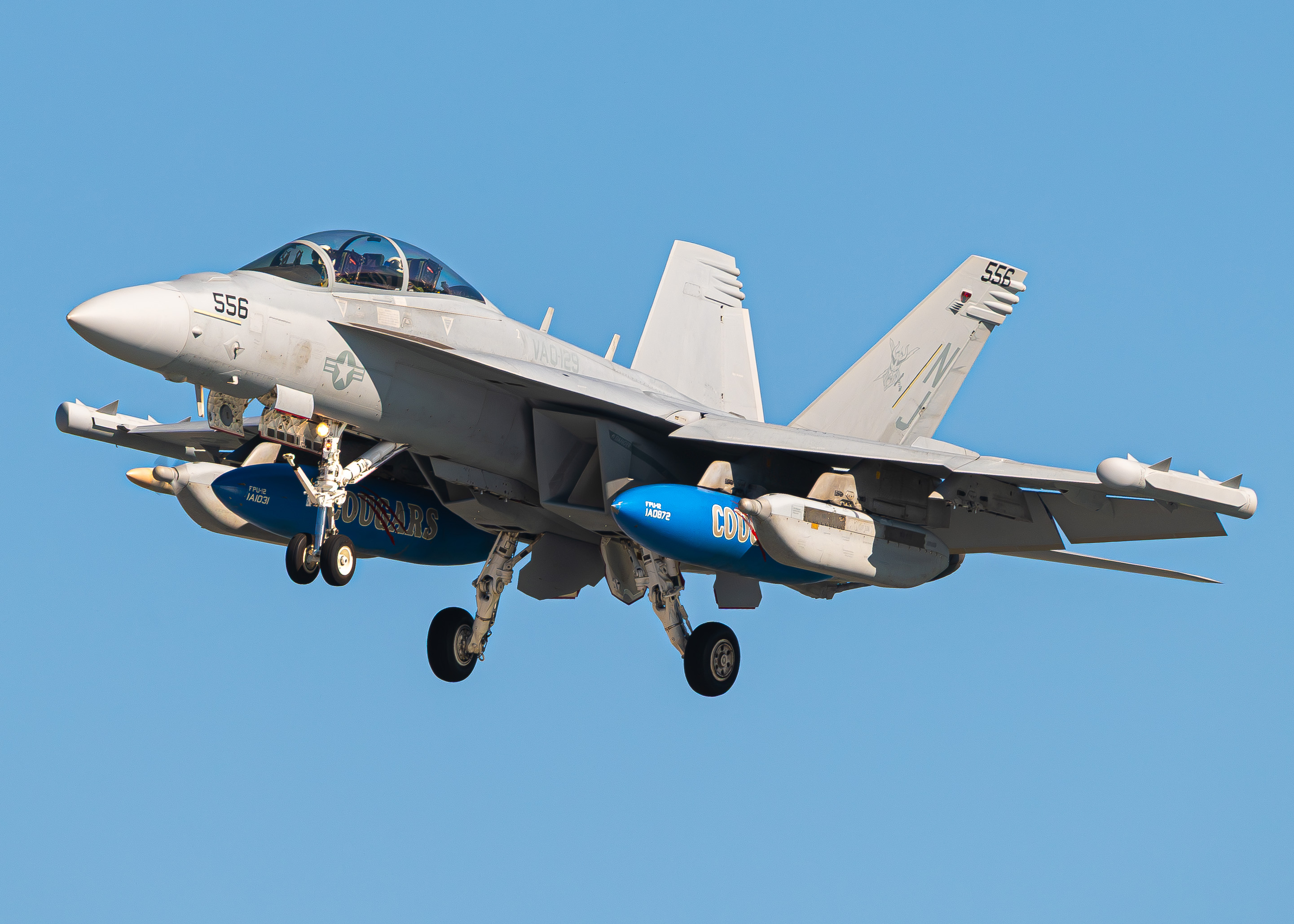
All four aircrew aboard two United States Navy EA-18G Growler jets survived a dramatic and extraordinarily rare midair collision at the Gunfighter Skies Air Show at Mountain Home Air Force Base in western Idaho on Sunday, May 17, 2026, ejecting from their aircraft and parachuting to safety as the two planes, apparently locked together after the impact, tumbled toward the ground in full view of an audience watching the aerial demonstration below. The incident, which occurred at approximately 12:10 PM Mountain Daylight Time, two miles from the base, is now under a formal Navy investigation and has drawn immediate attention from aviation safety experts, who note that surviving a midair collision with all four crew members intact is, by any statistical measure, a remarkable outcome.
What Happened Over Mountain Home
Two E/A-18G Growler jets from Electronic Attack Squadron (VAQ) 129, based at Whidbey Island, Washington, collided in midair two miles from the base during the two-day Gunfighter Skies Air Show.
The two jets with four aircrew collided "while performing an aerial demonstration" at around 12:10 p.m. MDT, Cmdr. Umayam added, noting that all four crew members ejected safely.
Cmdr. Amelia Umayam, spokesperson for Naval Air Forces, US Pacific Fleet, confirmed the survival of all four aviators with a statement that balanced urgency with precision:
“All four of the aircrew successfully ejected, and they are being evaluated by medical personnel. First responders are on the scene.”
The crew members were in stable condition, base officials said. Nobody at the military base was hurt, said Kim Sykes, marketing director with Silver Wings of Idaho, which helped to plan the air show.
The official investigation status was summarised directly: "The incident is under investigation. More information will be released as it becomes available," Umayam said.
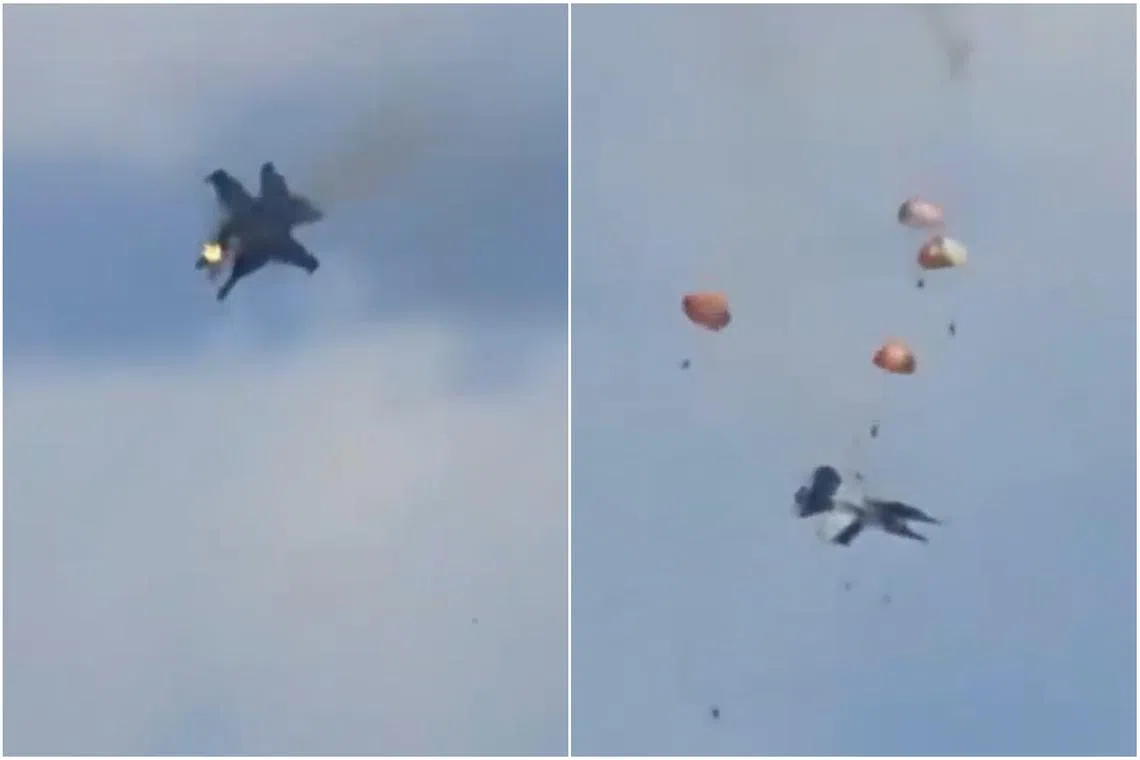
Photo: CLASHREPORT/X
The Physics That May Have Saved Four Lives
The most significant question surrounding Sunday's collision is not only how it happened but why all four crew members survived, an outcome that aviation safety experts describe as statistically improbable in a conventional midair collision scenario.
It was remarkable that both crews were able to eject from their planes, and aviation safety expert Jeff Guzzetti said that may have been possible because of the way the planes collided and appeared to remain stuck together in midair before falling to Earth. Crews usually don't have a chance to eject in a midair collision, he said.
"It's really striking to see," Guzzetti said. "It looks like they struck each other in a very unique fashion to cause them to remain intact and kind of stick to each other, and that very well could have saved them."
Video footage captured by spectators and subsequently shared on social media appeared to confirm this analysis, showing the two jets entangled at altitude and descending together before all four ejection seats fired. Had the collision violently separated the aircraft or instantly destroyed the structural integrity of either jet, the window for successful ejection would have been measured in fractions of a second, likely insufficient for four crew members across two aircraft to act.
The weather conditions at the time of the incident added a further operational variable. The National Weather Service reported good visibility and winds gusting up to 29 mph around the time of the crash. Gusting crosswinds are a known complicating factor in formation flying demonstrations, where spacing between aircraft is measured in feet, and any unexpected displacement carries immediate collision risk.
The Aircraft: EA-18G Growler
The aviators and two jets were part of the Navy's EA-18G Growler Demonstration Team, which was performing at Mountain Home Air Force Base, Idaho.
The EA-18G Growler is a highly specialised variant of the Boeing F/A-18F Super Hornet, configured for electronic attack operations, jamming enemy radar and communications systems rather than primarily for kinetic combat. Each Growler is crewed by two aviators: a pilot and an electronic warfare officer seated in tandem, which explains why the two aircraft involved carried a total of four personnel rather than two.
The Growler Demonstration Team performs at airshows across the United States to showcase the capabilities of the platform and the naval aviation community. The team's performances involve precision formation manoeuvres that, by their nature, require aircraft to fly in close proximity, a factor that becomes a critical context for any collision investigation involving demonstration team operations.
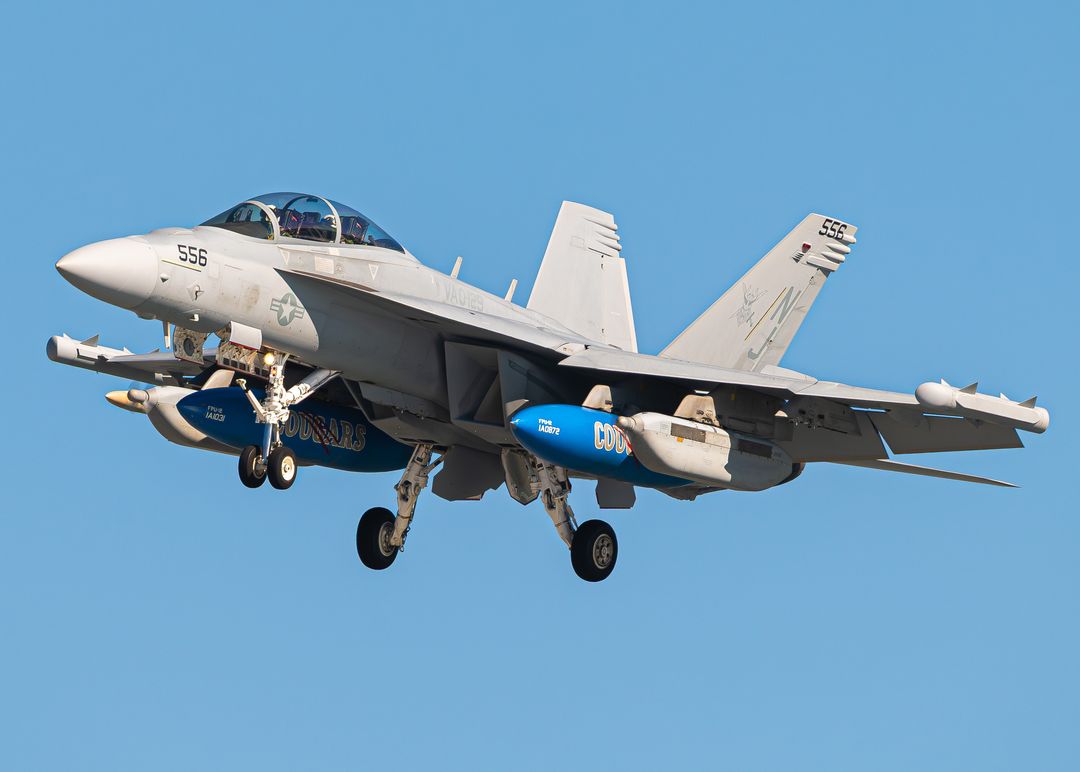
Photo: Pablo Armando Armenta

Analysis: How Spirit Airlines Changed Airline Pricing, then Paid the Price
The Cause: "A Pilot Issue"
Jeff Guzzetti, who served as a senior accident investigator at both the FAA and the NTSB, offered his preliminary assessment of the probable cause category with characteristic directness:
"It appears to be a pilot issue to me."
Investigators may benefit considerably from a factor that is rarely available after midair collisions: investigators may be able to quickly get an idea of what happened in Sunday's crash because the crews of both planes survived and will be able to tell investigators what they saw and experienced before the collision.
The survival of all four crew members gives investigators access to four first-hand accounts of the seconds immediately preceding the impact, a body of testimony that is extraordinarily unusual in fatal or near-fatal aircraft accident investigations and that significantly accelerates the inquiry's ability to reconstruct the sequence of events.
Air Show Safety in Context
The collision at Mountain Home invites examination against the broader safety record of US air shows, a record that has, in recent years, been notably strong.
The air show industry has been working to improve safety for years at the roughly 200 events held each year in the US. The last fatal crash at a US air show came in 2022 when two vintage military planes collided at an event in Dallas and killed six people.
John Cudahy, president and CEO of the International Council of Air Shows, said that there used to be an average of about two deaths a year at a US air show. But over the past decade, the average has been closer to one death per year. There were no air show deaths in 2025 or 2024, and a spectator hasn't been killed at an air show in the US since 1952. "Safety-wise, we've enjoyed really an unprecedented term of few accidents," Cudahy said.
The absence of spectator casualties on Sunday, combined with the survival of all four aircrew, means that the May 17 collision, while dramatic, costly in aircraft and likely significant in its implications for demonstration team procedures, does not interrupt what has been an extraordinary period of safety improvement in civilian air show operations. The destruction of two front-line Navy aircraft and the ejection of their crews in front of a public audience is, however, a serious military aviation event that will generate a thorough and detailed investigation regardless of the absence of fatalities.
The Gunfighter Skies Air Show was paused following the incident. Mountain Home Air Force Base confirmed all personnel at the installation were safe, and the base's emergency response teams were among the first to reach the crews after they parachuted to the ground.
Amazon Suspends Cargo Carrier 21 Air After Deadly Miami Runway Crash » Major US Airlines Push Back Against Air China's Request for Additional US Flights » Frontier Airlines Passengers Stranded Overnight After Crew Timeout From Weather Diversion »

Comments (0)
Add Your Comment
TAGS
NEWS US Navy EA-18G Growler Midair Collision Mountain Home Air Force Base Gunfighter Skies Air Show VAQ-129 Navy Ejection Idaho Air Show Jeff Guzzetti Cmdr Amelia Umayam Air Show Safety Naval Aviation Military Aircraft Accident Whidbey Island Aviation News 2026RECENTLY PUBLISHED
 This Week in Aviation: The 10 Stories That Mattered Most
From major airline developments to aircraft updates and industry shifts, this weekly recap highlights the ten most-read aviation stories from the week of September 13.
INFORMATIONAL
READ MORE »
This Week in Aviation: The 10 Stories That Mattered Most
From major airline developments to aircraft updates and industry shifts, this weekly recap highlights the ten most-read aviation stories from the week of September 13.
INFORMATIONAL
READ MORE »
 One-Millisecond Software Defect Identified as Cause of UK Air Traffic Control Collapse That Grounded Thousands of Flights
A new NATS report reveals a one-millisecond software defect triggered the UK air traffic control failure, causing thousands of cancellations.
NEWS
READ MORE »
One-Millisecond Software Defect Identified as Cause of UK Air Traffic Control Collapse That Grounded Thousands of Flights
A new NATS report reveals a one-millisecond software defect triggered the UK air traffic control failure, causing thousands of cancellations.
NEWS
READ MORE »
 AirAsia Pushes Back on Collapse Rumors as Fuel Costs Squeeze Budget Airline
AirAsia CEO Tony Fernandes denies the airline faces collapse, saying travel demand stays strong despite rising jet fuel prices pressuring margins.
NEWS
READ MORE »
AirAsia Pushes Back on Collapse Rumors as Fuel Costs Squeeze Budget Airline
AirAsia CEO Tony Fernandes denies the airline faces collapse, saying travel demand stays strong despite rising jet fuel prices pressuring margins.
NEWS
READ MORE »
More than just headlines.
Get unlimited ad-free access to in-depth aviation news, premium stories, and exclusive insights other sites don't cover.
- Ad-free browsing on AeroXplorer
- Unlimited access to premium and exclusive articles
- Higher photo upload limits & commissions on sales
- Free access to Jetstream Magazine on higher tiers
- Ad-free browsing
- Sell aviation photos with 60% commission
- First week free!
- Everything in Basic+
- Unlimited premium articles
- Sell aviation photos with 70% commission
- Free Digital subscription to Jetstream Magazine
- First week free!
- Everything in Basic+ and Pro
- Sell aviaiton photos with 80% commission
- Early access to exclusive stories
- Free Digital+Print subscription to Jetstream Magazine