
Join us virtually next week. Free to attend • Seats are limited.
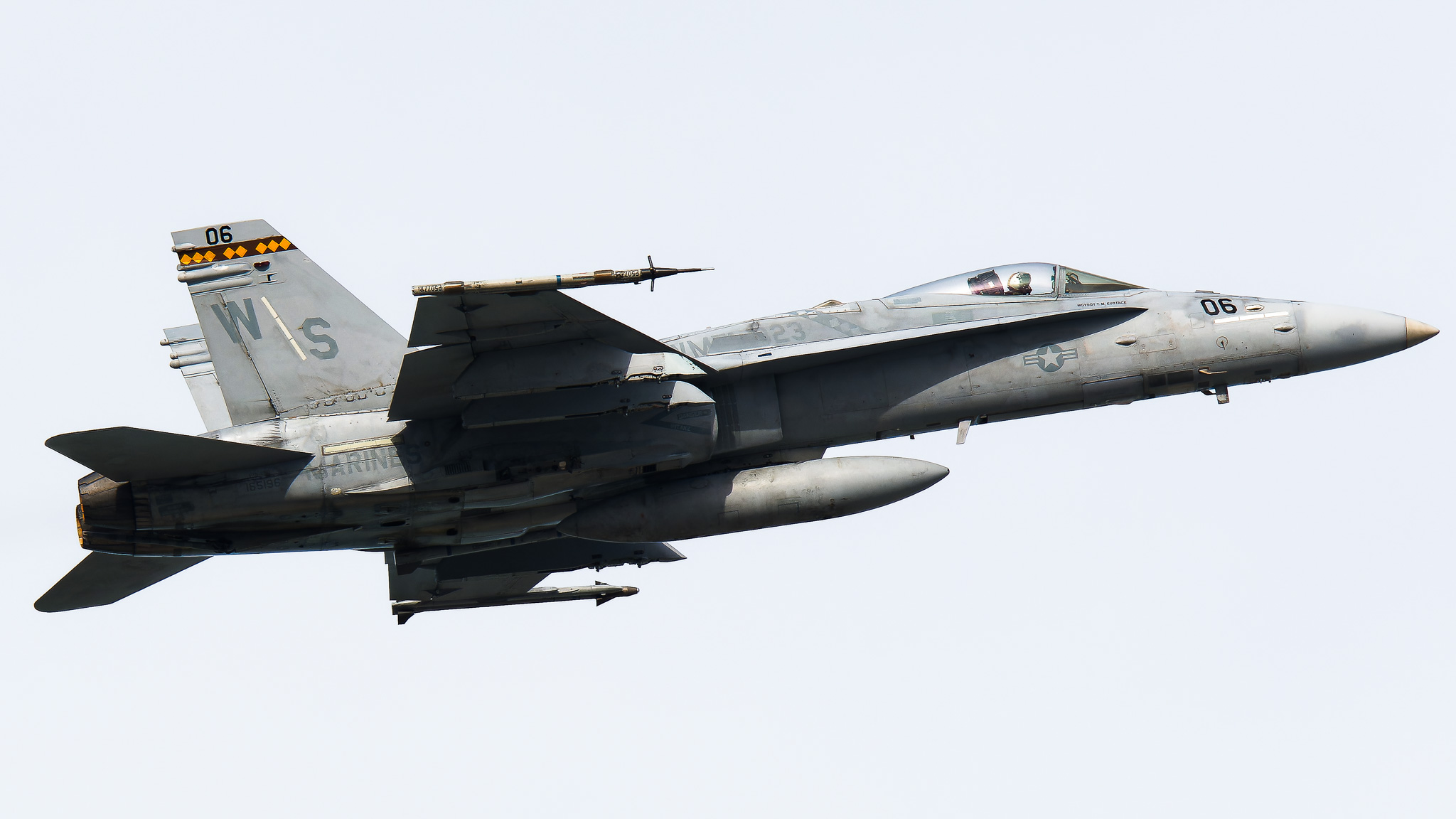
A United States Marine Corps F/A-18 Hornet crashed in the Gifford Pinchot National Forest in southern Washington state, igniting a wildfire in the rugged terrain near Mount Adams. The pilot ejected and survived the incident, according to military officials.
The single-seat fighter went down during a routine training mission. Recovery crews reached the pilot, who sustained no life-threatening injuries. The aircraft, however, was destroyed on impact, and the crash site triggered a fire that drew an immediate response from federal wildland firefighting resources.
What We Know About the Crash
The downed aircraft belonged to Marine Fighter Attack Squadron 312 (VMFA-312), known as the "Checkerboards," based at Marine Corps Air Station Beaufort, South Carolina. The squadron flies the legacy F/A-18C Hornet, one of the dwindling number of Hornet units still operating the airframe as the Marine Corps transitions to the F-35C Lightning II.
According to initial reports, the jet was operating out of Naval Air Station Whidbey Island at the time of the mishap. The Marine Corps confirmed the crash occurred during a training flight, though officials have not disclosed the specific nature of the exercise or the altitude at which the aircraft was operating when the pilot ejected.
The pilot, whose name has not been released pending notification procedures, was recovered by emergency responders and transported for medical evaluation. No personnel on the ground were injured, and the remote location of the crash site spared nearby communities from direct harm.

Photo: AeroXplorer/ Dalton Hoch
Wildfire Response Underway
The impact and subsequent fuel ignition started a wildfire in a heavily forested area within the Gifford Pinchot National Forest, a 1.3-million-acre expanse of old-growth timber, volcanic peaks, and steep canyons. The U.S. Forest Service dispatched fire crews to contain the blaze, which presented a significant logistical challenge given the area's terrain and limited access roads.
The forest service has not yet released acreage estimates for the fire, though officials indicated that the wreckage of the aircraft remains within the active burn area. Recovery of the jet's components, including the flight data recorder and any classified equipment, will likely wait until fire crews secure the site.
The Gifford Pinchot National Forest spans portions of Skamania, Lewis, Yakima, and Cowlitz counties, and parts of the area have been under elevated fire danger conditions throughout the summer months.

The Cockpit’s Next Revolution: When the Co-Pilot Is a Computer
The Aircraft Involved
The F/A-18 Hornet first entered service with the Marine Corps in 1983 and has served as the backbone of Marine fixed-wing aviation for more than four decades. The C variant, a single-seat, twin-engine multirole fighter, was designed to perform both air-to-air and air-to-ground missions from carrier decks and expeditionary airfields.
The Marine Corps has been gradually retiring its legacy Hornet fleet as squadrons transition to the F-35B and F-35C Lightning II. Several Marine Hornet squadrons have already sundowned their F/A-18s, and the service plans to complete the transition over the coming years. The remaining Hornets in the fleet have accumulated significant flight hours, and the Marine Corps has invested in service-life extension programs to keep the jets airworthy until F-35 deliveries are complete.
For aviation enthusiasts, the legacy Hornet remains a notable airframe, distinct from the larger F/A-18E/F Super Hornet flown by the U.S. Navy. The Marine Corps is the last U.S. military operator of the legacy C and D models.

Photo: AeroXplorer/ Jack O'Brien
Recent Mishaps in the Hornet Community
This crash adds to a troubling string of incidents involving legacy F/A-18s in recent years. The aging fleet, combined with high operational tempo, has presented maintenance and readiness challenges for the Marine Corps. The service has worked to balance the demands placed on remaining Hornet squadrons against the realities of an airframe approaching the end of its service life.
The Naval Safety Command classifies aviation mishaps according to severity, with Class A mishaps involving fatalities, permanent total disability, or property damage exceeding 2.5 million dollars. The destruction of an F/A-18 Hornet, valued at approximately 29 million dollars, will almost certainly qualify the incident as a Class A mishap.
Investigation to Follow
The Marine Corps will convene a formal investigation to determine the cause of the crash. Investigators typically examine maintenance records, pilot qualifications, flight data, weather conditions, and any communications between the aircraft and air traffic control or training range coordinators. The process can take months to complete, and findings are often released in summary form once the investigation concludes.
Mechanical failure, pilot disorientation, bird strikes, and weather-related factors are among the variables investigators consider in these cases. Until the wreckage is recovered and analyzed, officials have declined to speculate on what brought the aircraft down.
The successful ejection underscores the reliability of the Martin-Baker ejection seats installed in the F/A-18, which have saved hundreds of aviators over the type's service life. Survivability in modern ejection events has improved markedly compared to earlier generations of fighter aircraft, though the physical toll on pilots can still be substantial.
Additional details are expected as the Marine Corps and federal forestry officials release further information on the recovery operation and the status of the wildfire.
Security Breach at Fort Lauderdale Airport: Intruder Found Sleeping on JetBlue A320 in Maintenance Hangar » Cape Town Airport Runway Shut After Kenya Airways Boeing 737-800 Tire Failure » Delta Air Lines Launches Non-Stop Atlanta to Riyadh Service on October 23 Despite Regional Tensions »

Comments (0)
Add Your Comment
TAGS
NEWS F/A-18 Hornet Military Aviation Training Flight Aircraft Crash Washington National Forest Fighter Jet Pilot Safety Aircraft LossRECENTLY PUBLISHED
 Solairus Moves to Acquire Clay Lacy Charter Business, Forming a 500-Aircraft Management Powerhouse
Solairus Aviation's acquisition of Clay Lacy's charter management operation creates one of the largest managed fleets in U.S. business aviation.
NEWS
READ MORE »
Solairus Moves to Acquire Clay Lacy Charter Business, Forming a 500-Aircraft Management Powerhouse
Solairus Aviation's acquisition of Clay Lacy's charter management operation creates one of the largest managed fleets in U.S. business aviation.
NEWS
READ MORE »
 Joby Aviation Opens Texas Facility to Prepare for Dallas-Fort Worth Air Taxi Service
Joby Aviation has established a new Texas base to support planned electric air taxi operations across the Dallas-Fort Worth region.
NEWS
READ MORE »
Joby Aviation Opens Texas Facility to Prepare for Dallas-Fort Worth Air Taxi Service
Joby Aviation has established a new Texas base to support planned electric air taxi operations across the Dallas-Fort Worth region.
NEWS
READ MORE »
 Airbus and Boeing Pursue Out-of-Autoclave Composites to Speed Next-Generation Airframe Production
Airbus and Boeing are investing in out-of-autoclave composite technologies to accelerate airframe manufacturing rates for future single-aisle aircraft programs.
NEWS
READ MORE »
Airbus and Boeing Pursue Out-of-Autoclave Composites to Speed Next-Generation Airframe Production
Airbus and Boeing are investing in out-of-autoclave composite technologies to accelerate airframe manufacturing rates for future single-aisle aircraft programs.
NEWS
READ MORE »
More than just headlines.
Get unlimited ad-free access to in-depth aviation news, premium stories, and exclusive insights other sites don't cover.
- Ad-free browsing on AeroXplorer
- Unlimited access to premium and exclusive articles
- Higher photo upload limits & commissions on sales
- Free access to Jetstream Magazine on higher tiers
- Ad-free browsing
- Sell aviation photos with 60% commission
- First week free!
- Everything in Basic+
- Unlimited premium articles
- Sell aviation photos with 70% commission
- Free Digital subscription to Jetstream Magazine
- First week free!
- Everything in Basic+ and Pro
- Sell aviaiton photos with 80% commission
- Early access to exclusive stories
- Free Digital+Print subscription to Jetstream Magazine