


Join us virtually next week. Free to attend • Seats are limited.
Emirates has delivered the most remarkable set of airline financial results in recent memory, posting record pre-tax profits of $6.2 billion for the financial year ending March 31, 2026, even though the final month of that year included the most catastrophic disruption to Gulf aviation since the COVID-19 pandemic. Released on May 7, 2026, the results confirm Emirates as the world's most profitable airline for the second consecutive year and reveal that the carrier used its strongest financial position ever to purchase 29 Airbus A380 superjumbos outright, cementing its long-term commitment to the double-decker jet that no other manufacturer can build and no other airline operates at a comparable scale.
Record Results Against a Backdrop of War
On Thursday, the Emirates Group, which includes several subsidiaries and ground operations companies such as Dnata, reported a profit of $6.6 billion, while Emirates Airline reported a pre-tax profit of $6.2 billion, both of which were up 7% on the previous year. Once new tax rules are taken into account, the Emirates Group's post-tax profit was $5.7 billion, which is a record-breaking year for the aviation conglomerate.
Profit before tax rose 7% to AED22.8 billion ($6.2 billion) in the year to March 31. The results follow one of the most turbulent periods for Gulf aviation since the Covid-19 pandemic, with airspace closures, missile and drone attacks and widespread flight disruptions affecting operations across the Middle East during the final weeks of Emirates' financial year.
Full-year revenues reached Dhs130.9 billion, up 2%, despite a slight dip in the number of passengers to 53.2 million, down 1 per cent from a year ago, due to the Iran war. Load factor declined marginally to 78.4 per cent, from 78.9 per cent in the previous fiscal year.

The Month That Could Have Wrecked Everything
The final month of the financial year tested Emirates at every level, operationally, commercially, and in terms of crew safety and welfare. On March 1, Emirates flew just 24 flights. An airline that normally operates over 2,000 daily flights was, at the peak of the crisis, reduced to a skeleton of its scheduled operation.
Dubai International Airport, the world's busiest, reported a 66 per cent drop in passenger numbers for March.
Sheikh Ahmed bin Saeed Al Maktoum, Chairman and Chief Executive of the Emirates Group, addressed the human dimension of that month directly in an internal memo:
"March 2026 will fade into memory, but we will never forget your bravery and incredible resilience. You were called upon during one of the most complex and challenging times in our history, and you showed up with commitment and passion. For that, I will remain forever grateful to you."
The group chairman placed the full-year result in its proper context:
"Despite an extremely challenging March before our financial year ended, Emirates retains its place as the world's most profitable airline."
He described the months leading up to the conflict in terms that illustrate how strong the underlying business had been. "Month after month, we were surpassing our targets," said Al Maktoum, while addressing the challenges thrown up by the war in Iran.
The Fuel Hedge That Protected the Balance Sheet
One strategic decision protected Emirates from the worst of the fuel cost shock that has devastated less well-prepared carriers. Emirates says that it had hedged fuel through to 2028-2029, giving it a significant buffer against surging oil prices, as the airline has already locked in the price it will pay for fuel at pre-war prices.
A $1 movement in the oil price has an adverse impact of about AED327 million on profitability. Emirates has hedged part of its expected fuel needs for up to the next three years. At the end of March, these fuel hedging contracts were worth AED45 billion in total. About half of its expected Brent crude fuel costs for each of the next three years had already been locked in.
Jet fuel in the Middle East cost $177 per barrel in the week ending May 1, according to the International Air Transport Association, up 111% year-on-year. For unhedged carriers absorbing that price at current market rates, the figure is catastrophic. For Emirates, the pre-war hedges have acted as a partial shield, one that will erode as existing contracts roll off, but that has preserved profitability through the current crisis period.
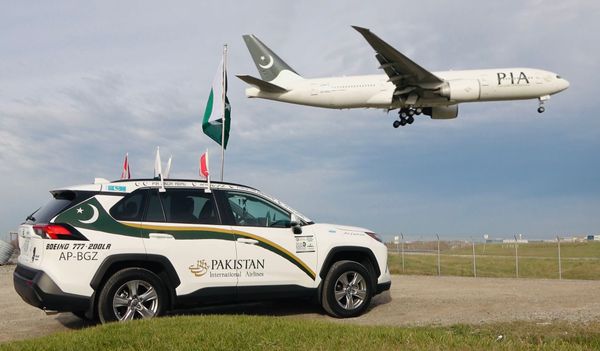
A 777 on Four Wheels? Inside One Superfan’s Mission to Celebrate His Favorite Airline
29 A380s Bought at the Peak of Profitability
The most striking strategic disclosure in the annual results is not the profit figure itself but what Emirates chose to do with its financial position during the year. Emirates acquired 34 previously-leased aircraft over its most recent financial year, comprising 29 Airbus A380s and five Boeing 777s. The Dubai-based airline also took delivery of 15 A350-900s as well as five 777Fs.
The 29 Airbus A380s acquired during the fiscal year were already active within its fleet and nearing the end of their leasing contracts. By purchasing the aircraft outright, the airline can reduce future leasing expenses while maintaining operational control over its flagship double-decker fleet. The airline did not disclose the exact value of the A380 acquisitions. However, Emirates stated that it invested approximately $4.9 billion during the year across aircraft, infrastructure, technology upgrades, and operational facilities.
Emirates' fleet, at the end of fiscal 2025-26, stood at 277 aircraft comprising 116 A380s and 142 777s, plus 19 A350s.
The A380's commercial performance justified every one of those acquisitions. The A380 remains "central" to its network, carrying 43% of Emirates' passengers during the year with a load factor of 79%. The airline says this demonstrates the double-deck jet's "commercial potency" and "enduring appeal" to customers.
Emirates remains the world's largest Airbus A380 operator and has repeatedly confirmed its commitment to flying the aircraft into the next decade, with executives now targeting operations through at least 2040 and potentially beyond.

Emirates Key Network Operations
| Flight No. | Route | Departure Time | Arrival Time | Duration | Operating Days |
|---|---|---|---|---|---|
| EK001 | Dubai (DXB) → London Heathrow (LHR) | 8:10 AM | 12:30 PM BST | ~7h 20m | Daily (A380) |
| EK002 | London Heathrow (LHR) → Dubai (DXB) | 2:00 PM BST | 12:05 AM+1 | ~7h 05m | Daily (A380) |
| EK201 | Dubai (DXB) → New York JFK (JFK) | 8:30 AM | 2:25 PM EDT | ~13h 55m | Daily (A380) |
| EK202 | New York JFK (JFK) → Dubai (DXB) | 11:35 PM EDT | 8:30 PM+1 | ~11h 55m | Daily (777-300ER) |
| EK448 | Dubai (DXB) → Auckland (AKL) | 10:05 AM | 10:55 AM+1 NZST | ~15h 50m | Daily (A380) |
| EK449 | Auckland (AKL) → Dubai (DXB) | 9:10 PM NZST | 5:35 AM+1 | ~17h 25m | Daily (A380) |
| EK255 | Dubai (DXB) → Barcelona (BCN) → Mexico City (MEX) | 3:45 AM | 4:00 PM MEX | ~22h+ | Daily (777-300ER) |
| EK407 | Dubai (DXB) → Sydney (SYD) | 9:55 AM | 9:55 AM+1 AEST | ~14h 00m | Daily (A380) |
| EK231 | Dubai (DXB) → Orlando (MCO) | 3:30 AM | 9:45 AM EDT | ~16h 15m | 6x Weekly (777-300ER) |
| EK521 | Dubai (DXB) → Da Nang (DAD) | 3:55 AM | 12:10 PM ICT | ~7h 15m | 4x Weekly (787-9) — New 2025-26 |
Emirates' fleet as of 31 March 2026: 116 Airbus A380s, 142 Boeing 777s, 19 Airbus A350-900s (277 total). 96% of global network is restored as of 4 May 2026. All times local. Passengers should verify schedules at emirates.com.
The Retrofit Programme Continuing at Scale
The A380 purchases coincide with the most extensive cabin upgrade programme in Emirates' history. Emirates has been carrying out cabin refurbishment and completed upgrades during the year on 42 aircraft, 30 777s and a dozen A380s. It has earmarked 215 jets for the work, and 91 have been refreshed so far.
The connectivity upgrade programme is proceeding simultaneously. Emirates now has Starlink connectivity live on 28 aircraft, with the first A380 having received the installation at Newquay Airport in April 2026, the world's first Starlink-equipped superjumbo. The airline also added four new destinations during the year: Da Nang, Hangzhou, Siem Reap, and Shenzhen, expanding its network to 152 cities in 80 countries by March 31.
The Road to Recovery and the Outlook for 2026-27
As of the results announcement date, Emirates has restored 96% of its global network following the disruption caused by the conflict. The airline operates to 137 destinations across 72 countries, with more than 1,300 weekly frequencies, representing 75% of pre-disruption capacity.
Al Maktoum was measured but clearly forward-focused in his commentary on what comes next:
“Right now, military activities between the US, Israel and Iran are paused under a ceasefire agreement. We hope for a clear resolution to the hostilities soon and a return to market stability. But in the meantime, we are not sitting on our hands.”
"Our fundamentals are strong. The Emirates Group's proven business model is unchanged. Dubai's place at the nexus of global commerce, trade and travel flows is unchanged. Our ambition to be the best in the world, and to be of service to the world, is unchanged," added Al Maktoum.
The Emirates Group is entering 2026-27 with "very strong cash reserves, which will enable us to progress with our plans to strengthen our business without knee-jerk cost-control measures," Sheikh Ahmed said.
The order book underlines that long-term confidence. The carrier has 367 aircraft on order (270 Boeing 777Xs, 35 787s, eight 777Fs and 54 A350s) with deliveries scheduled through to 2038. For an airline that has just reported the best full-year profit in its history during the most disruptive month in Gulf aviation in years, that forward investment signals an organisation that is not hedging its own future.
Iberia to Fly Researchers Above the Clouds for Spain's First Total Solar Eclipse in Over a Century » Engineer Fired Over 17-Minute Singapore Airlines Delay Wins $28,000 in Unfair Dismissal Case » Silk Way West 747-8 Diverts to Dallas After Houston Mix-Up, Declares Fuel Emergency »

Comments (0)
Add Your Comment
TAGS
ROUTES Emirates Emirates Annual Results World Most Profitable Airline Airbus A380 Emirates Fleet Iran War Aviation Emirates Record Profit Dubai Airport Emirates Fuel Hedge A380 Fleet Expansion Emirates 777X Order Emirates Network Restoration Emirates A350 Flights Routes TravelRECENTLY PUBLISHED
 SWISS To Retire Entire A220-100 Fleet Just a Decade After Launch
SWISS will phase out its nine Airbus A220-100 aircraft by the end of 2027, just ten years after introducing the type to its fleet.
NEWS
READ MORE »
SWISS To Retire Entire A220-100 Fleet Just a Decade After Launch
SWISS will phase out its nine Airbus A220-100 aircraft by the end of 2027, just ten years after introducing the type to its fleet.
NEWS
READ MORE »
 Security Breach at Fort Lauderdale Airport: Intruder Found Sleeping on JetBlue A320 in Maintenance Hangar
A man breached security at Fort Lauderdale-Hollywood International Airport and boarded a JetBlue plane, where crews later found him asleep in the lavatory.
NEWS
READ MORE »
Security Breach at Fort Lauderdale Airport: Intruder Found Sleeping on JetBlue A320 in Maintenance Hangar
A man breached security at Fort Lauderdale-Hollywood International Airport and boarded a JetBlue plane, where crews later found him asleep in the lavatory.
NEWS
READ MORE »
 Hill Helicopters Fires Up First British Clean-Sheet Turbine Engine in Six Decades
UK-based Hill Helicopters has completed the first run of its GT50 turboshaft, the first clean-sheet British helicopter turbine engine in 60 years.
NEWS
READ MORE »
Hill Helicopters Fires Up First British Clean-Sheet Turbine Engine in Six Decades
UK-based Hill Helicopters has completed the first run of its GT50 turboshaft, the first clean-sheet British helicopter turbine engine in 60 years.
NEWS
READ MORE »
More than just headlines.
Get unlimited ad-free access to in-depth aviation news, premium stories, and exclusive insights other sites don't cover.
- Ad-free browsing on AeroXplorer
- Unlimited access to premium and exclusive articles
- Higher photo upload limits & commissions on sales
- Free access to Jetstream Magazine on higher tiers
- Ad-free browsing
- Sell aviation photos with 60% commission
- First week free!
- Everything in Basic+
- Unlimited premium articles
- Sell aviation photos with 70% commission
- Free Digital subscription to Jetstream Magazine
- First week free!
- Everything in Basic+ and Pro
- Sell aviaiton photos with 80% commission
- Early access to exclusive stories
- Free Digital+Print subscription to Jetstream Magazine