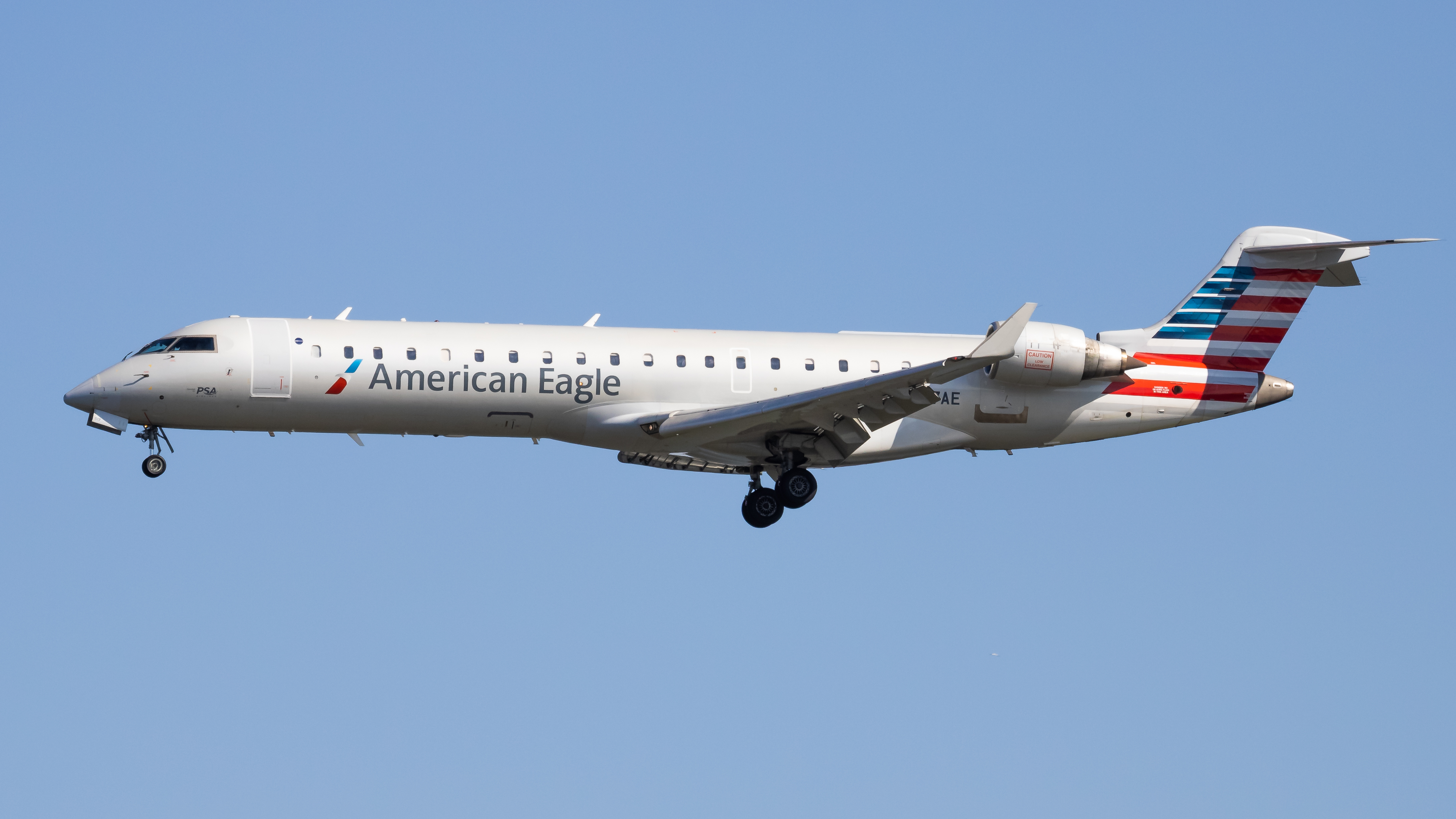

Federal aviation safety officials have launched an investigation into a high-speed runway incident at Ronald Reagan Washington National Airport (DCA) that left an American Eagle regional jet with a gaping hole in its nose. The aircraft, a Bombardier CRJ-700 operated by PSA Airlines, was forced to execute an emergency diversion on the evening of March 9 after striking unidentified foreign object debris (FOD) during its takeoff roll.
The flight, operating as American Airlines Flight 5561, was bound for Birmingham-Shuttlesworth International Airport (BHM) with a full load of passengers when the crew reported a significant impact while accelerating down Runway 15. Despite the jolt, the aircraft became airborne, but the flight crew immediately halted the climb at 4,000 feet after sensing an aerodynamic or structural anomaly.

Sixteen Minutes of High-Stakes Flying
Realizing the severity of the potential damage, the pilots declared an emergency and requested an immediate diversion to Washington Dulles International Airport (IAD), which offers longer runways and more expansive emergency facilities than the constrained airfield at Reagan National.
According to flight tracking data, the jet spent a total of only 16 minutes in the air. Upon touchdown at Dulles, ground crews were met with a startling sight: a substantial puncture in the aircraft’s radome, the fiberglass "nose cone" that protects vital weather radar equipment.
The Federal Aviation Administration (FAA) issued an official statement shortly after the inspection:
“The aircraft struck an object on takeoff from DCA and diverted to IAD, where a post-flight inspection revealed a hole in the radome.”
Alaska Goes Global: How Hawaiian Airlines Changed the Carrier’s Future
Rapid Repairs and Return to Service
The aircraft involved, a 22-year-old CRJ-700 registered as N517AE, remained grounded at Dulles for less than 24 hours before being ferried to Wichita (ICT), home to a major Bombardier service center. Maintenance teams worked through the night to replace the damaged composite structure and verify the integrity of the internal radar arrays.
Industry reports from the Aviation Herald and Simple Flying noted that the flight crew’s quick decision-making likely prevented more serious complications:
“The flight crew was aware of an impact and halted the climb at 4,000 feet before the decision was made to divert to nearby Washington Dulles International Airport (IAD), where the aircraft landed safely.”
In a testament to modern maintenance logistics, the aircraft was cleared for flight today, March 11, and is scheduled to return to regular passenger service with a route from DCA to Grand Rapids (GRR).

Safety Under the Microscope at DCA
This incident comes at a time of heightened sensitivity regarding operations at Reagan National. Following the tragic mid-air collision in early 2025, the airport has been under intense federal scrutiny regarding its congested runways and complex airspace. While bird strikes are a common cause of radome damage, the official classification of this event as a "foreign object strike" suggests a piece of runway hardware or debris from a previous aircraft may have been the culprit.
Airport authorities at DCA have reportedly conducted a "fine-tooth comb" inspection of Runway 15 to ensure no further projectiles remain that could threaten departing or arriving traffic.
Official Incident Flight and Recovery Details
The following table details the specific operations related to Flight AA5561 and the subsequent maintenance repositioning required to return the aircraft to service.
| Flight No. | Route | Departure Time | Arrival Time | Duration | Operating Days |
|---|---|---|---|---|---|
| AA 5561 | Wash. Reagan (DCA) – Wash. Dulles (IAD)* | 23:29 (ET) | 23:45 (ET) | 16m | March 9 (Emergency) |
| AA 9612 | Wash. Dulles (IAD) – Wichita (ICT) | 19:42 (ET) | 21:15 (CT) | 2h 33m | March 10 (Ferry) |
| AA 9615 | Wichita (ICT) – Wash. Reagan (DCA) | 07:15 (CT) | 10:48 (ET) | 2h 33m | March 11 (Return) |
| AA 5422 | Wash. Reagan (DCA) – Grand Rapids (GRR) | 12:59 (ET) | 14:48 (ET) | 1h 49m | March 11 (Service) |
*Originally scheduled for Birmingham (BHM); diverted due to an incident.
The swift return of N517AE to the skies underscores the high-velocity nature of regional maintenance networks, but the puncture in its nose remains a stark reminder of the hidden dangers lurking on even the most prestigious runways. As the FAA continues to analyze the debris recovered from Runway 15, the incident adds another layer of complexity to the ongoing safety dialogue surrounding Reagan National’s operations. For the passengers of Flight 5561, their sixteen-minute "flight to nowhere" serves as a testament to the razor-thin margins of aviation safety and the unwavering vigilance of the crew at the controls.
British Airways Returns to Tanzania After 15 Years With Direct Flights to Kilimanjaro and Zanzibar » Congressman Tom Tiffany Survives Emergency Plane Landing in Lake Wausau » Why Do Some Flights Take Longer Than Others on the Same Route? »

Comments (4)
 Brad Cruz
I am keenly interested in hearing what debris was recovered from the runway immediately after the incident. What could have hit the radome without hitting the wheel or flinging up to hit some other part of the airframe. Billssr1 is right to think bird strike but it's not certain. Inquiring minds want to know. If it was a piece of metal, what did it fall off of? Is there a ground vehicle or an aircraft missing some part? Maybe it was some hobbyist drone making video for the operators YouTube channel.
billssr1
Probably a bird strike, otherwise how would something get up off the runway to hit the plane in the nose ???
JB
amazing that there is no picture of the damage. Everyone takes pictures of their food at dinner,priority's I guess. One would think the pilots would have taken one.
fdb912
Your article begs for a photo of the damage. Surely someone took one. Why isn't it here?
Brad Cruz
I am keenly interested in hearing what debris was recovered from the runway immediately after the incident. What could have hit the radome without hitting the wheel or flinging up to hit some other part of the airframe. Billssr1 is right to think bird strike but it's not certain. Inquiring minds want to know. If it was a piece of metal, what did it fall off of? Is there a ground vehicle or an aircraft missing some part? Maybe it was some hobbyist drone making video for the operators YouTube channel.
billssr1
Probably a bird strike, otherwise how would something get up off the runway to hit the plane in the nose ???
JB
amazing that there is no picture of the damage. Everyone takes pictures of their food at dinner,priority's I guess. One would think the pilots would have taken one.
fdb912
Your article begs for a photo of the damage. Surely someone took one. Why isn't it here?
Add Your Comment
TAGS
NEWS American Eagle DCA PSA airlines Bombardier CRJ-700 Safety Incident Aviation SafetyRECENTLY PUBLISHED
 One-Millisecond Software Defect Identified as Cause of UK Air Traffic Control Collapse That Grounded Thousands of Flights
A new NATS report reveals a one-millisecond software defect triggered the UK air traffic control failure, causing thousands of cancellations.
NEWS
READ MORE »
One-Millisecond Software Defect Identified as Cause of UK Air Traffic Control Collapse That Grounded Thousands of Flights
A new NATS report reveals a one-millisecond software defect triggered the UK air traffic control failure, causing thousands of cancellations.
NEWS
READ MORE »
 AirAsia Pushes Back on Collapse Rumors as Fuel Costs Squeeze Budget Airline
AirAsia CEO Tony Fernandes denies the airline faces collapse, saying travel demand stays strong despite rising jet fuel prices pressuring margins.
NEWS
READ MORE »
AirAsia Pushes Back on Collapse Rumors as Fuel Costs Squeeze Budget Airline
AirAsia CEO Tony Fernandes denies the airline faces collapse, saying travel demand stays strong despite rising jet fuel prices pressuring margins.
NEWS
READ MORE »
 Delta Air Lines Moves to Claim Top Spot at LAX With New Routes and Expanded Schedule
Delta Air Lines plans its largest-ever schedule at Los Angeles International Airport, adding routes and premium seating to overtake rivals.
NEWS
READ MORE »
Delta Air Lines Moves to Claim Top Spot at LAX With New Routes and Expanded Schedule
Delta Air Lines plans its largest-ever schedule at Los Angeles International Airport, adding routes and premium seating to overtake rivals.
NEWS
READ MORE »
More than just headlines.
Get unlimited ad-free access to in-depth aviation news, premium stories, and exclusive insights other sites don't cover.
- Ad-free browsing on AeroXplorer
- Unlimited access to premium and exclusive articles
- Higher photo upload limits & commissions on sales
- Free access to Jetstream Magazine on higher tiers
- Ad-free browsing
- Sell aviation photos with 60% commission
- First week free!
- Everything in Basic+
- Unlimited premium articles
- Sell aviation photos with 70% commission
- Free Digital subscription to Jetstream Magazine
- First week free!
- Everything in Basic+ and Pro
- Sell aviaiton photos with 80% commission
- Early access to exclusive stories
- Free Digital+Print subscription to Jetstream Magazine