
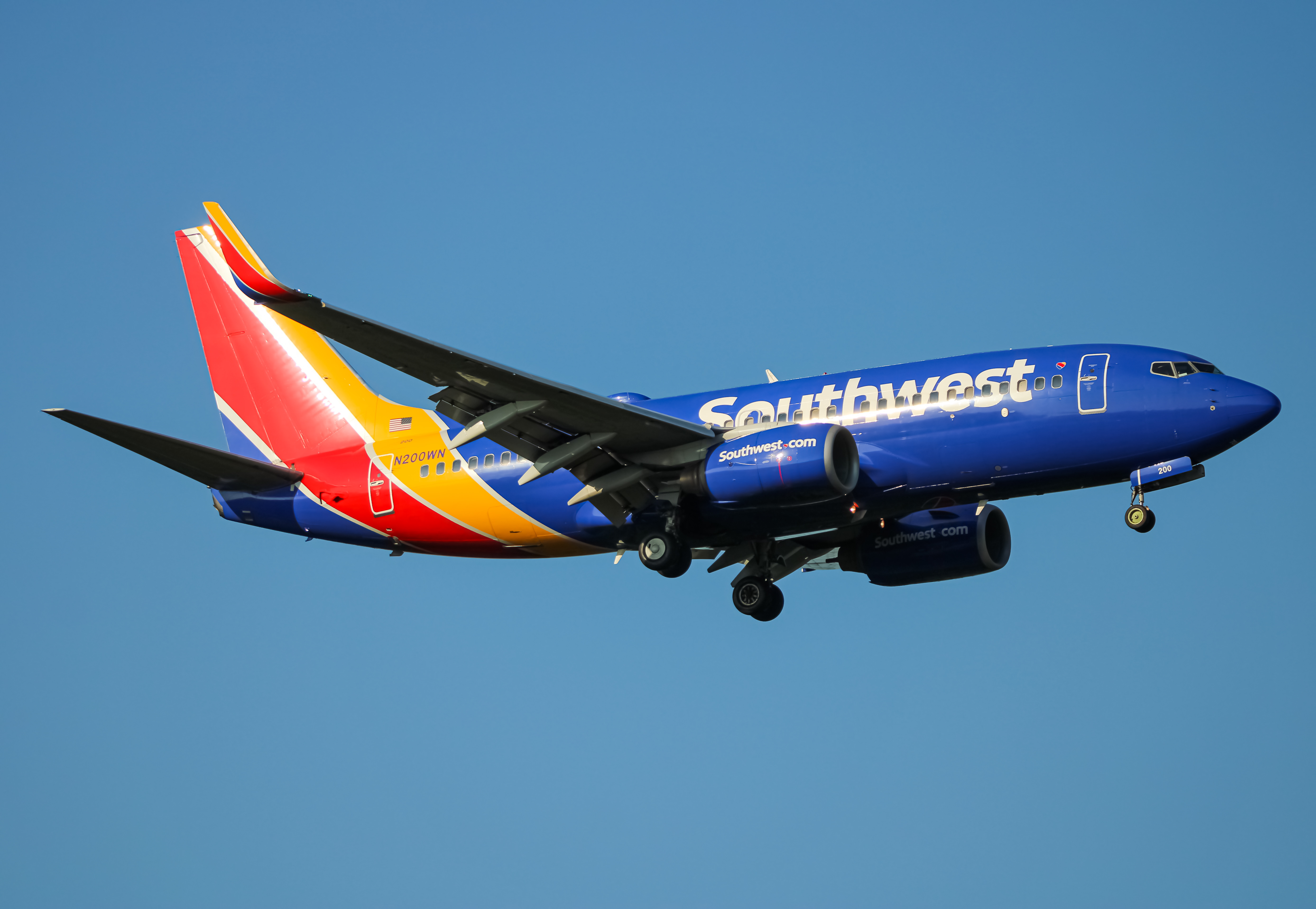

A Southwest Airlines Boeing 737-700 was forced to declare an emergency and return to Las Vegas on April 8, 2026, after the captain was struck on the head by a detached Head-Up Display unit during the takeoff roll. This extraordinary equipment failure incapacitated the flight's commander at one of the most critical phases of any flight. The First Officer took sole control of the aircraft, executed an emergency return, and landed the plane safely, averting what could have been a far more serious outcome.
What Happened Aboard Flight WN568
Southwest Airlines Boeing 737-700, registration N200WN, operating flight WN568 from Las Vegas Harry Reid International Airport to Reno-Tahoe International Airport, returned to Las Vegas shortly after departure following a captain incapacitation event. The incident occurred when the Head-Up Display unit on the captain's side detached and struck the captain on the head during the takeoff roll. The First Officer assumed control, coordinated with Air Traffic Control, and landed the aircraft safely back at Las Vegas on runway 26L.
The aircraft landed safely on runway 26L about 17 minutes after departure. The speed and composure with which the First Officer managed the emergency, from the initial impact through to touchdown and gate arrival, have been widely praised.

ATC Audio Reveals the Severity of the Impact
The full gravity of the situation became clear through radio communications between the First Officer and Las Vegas ground controllers, which were recorded and shared by the aviation monitoring account You Can See ATC. The exchange, which took place as the aircraft was taxiing to the gate after landing, paints a vivid picture of the cockpit event:
SWA 568: "Yeah, it's the captain's side HUD, it came down during the takeoff roll and smacked him pretty hard on the head."
ATC (Ground): "Southwest 568, roger. Something on the captain's side came down, you said?"
SWA 568: "Yeah, the heads-up display. It's a big unit, came down, smacked him on the head, made him see a few stars, and started throwing up."
Earlier in the sequence, the First Officer had already radioed Las Vegas Departure: "Yeah, it's just the HUD came down and hit him on the head on the takeoff roll, he'd like EMS when we return."
The Southwest Airlines Response
Southwest Airlines confirmed the incident and provided its own account of the sequence of events. The airline acknowledged the crew's decision to return as well as the captain's condition after landing.
"Southwest Airlines Flight 568 returned safely to Harry Reid International Airport in Las Vegas around 2:45 p.m. local time on April 8 after the crew reported a pilot injury," an FAA spokesperson told The Independent. "The flight was traveling to Reno-Tahoe International Airport."
Shortly after takeoff, the captain began to feel unwell, the airline said. That led both him and the first officer to decide to return to the airport. "The First Officer landed the aircraft, but the Captain felt well enough to taxi the plane safely to the gate," the Southwest Airlines spokesperson added.
A wheelchair was subsequently requested to remove the captain from the aircraft. The captain had sustained a mild concussion. The first officer advised that after landing, the captain had started throwing up.
The Cockpit’s Next Revolution: When the Co-Pilot Is a Computer
What a Head-Up Display Is and Why Its Failure Matters
A Head-Up Display is a transparent display system mounted in the pilot's forward field of view. It projects critical flight data such as airspeed, altitude, heading, and flight path directly onto a glass combiner, allowing pilots to monitor instruments without looking down at the instrument panel. Boeing 737 aircraft equipped with HUD systems typically mount the unit above the pilot's eye level on an articulating arm. A mechanical failure or latch malfunction could cause the unit to swing down unexpectedly, posing a direct physical hazard to the pilot seated below.
The HUD is not a lightweight component. Its articulating arm and combiner assembly constitute a solid, heavy unit designed to be mounted securely in a precise overhead position. During the dynamic forces generated on the takeoff roll, acceleration, vibration, and any imperfections in the runway surface, a compromised latch could allow the unit to swing downward with significant momentum, directly into the space occupied by the seated captain. This is precisely what appears to have occurred aboard N200WN on April 8.

Aircraft and Passengers Safe
Despite the drama in the cockpit, the incident did not result in any passenger injuries. The Boeing 737-700 (N200WN) sustained no structural or mechanical issues beyond the HUD malfunction, and all passengers and crew arrived safely at the gate.
The aircraft was able to depart again after about 90 minutes on the ground and reached Reno with a delay of about 2 hours. A replacement crew took command of the aircraft for the rescheduled departure, with the incapacitated captain having been removed by medics upon arrival at the gate.
Two-Pilot Redundancy Proves Its Worth
Whatever the outcome of any subsequent investigation, the April 8 incident is a striking demonstration of why commercial aviation mandates two qualified pilots on the flight deck for every departure. As has been noted in previous Southwest incapacitation events, with two pilots on every flight, the captain and the first officer are "equally qualified and trained" to operate the plane by themselves if the other becomes incapacitated.
On Flight WN568, the First Officer executed precisely that protocol, taking control at the most critical moment, managing the emergency communications with ATC, and bringing 26L to a safe stop with the aircraft, passengers, and remaining crew intact. The outcome, while deeply concerning from a maintenance and airworthiness standpoint, is ultimately a story of CRM (Crew Resource Management) training working exactly as designed.
NBC NewsChopper 4 Crash in Los Angeles Kills Three, Injures Two While Covering Fatal Bus Collision » Frontier Airlines Passengers Stranded Overnight After Crew Timeout From Weather Diversion » Emirates Wins Approval for Direct Berlin Flights After 22-Year Push »

Comments (11)
 Rick
Your description of the HGS system on the aircraft is incorrect. What hit the pilot is the overhead projector. The combiner is not attached to that aside from a cable running from the overhead to the said combiner.
Paul Ipolito
Recommended for you
The Cockpit’s Next Revolution: When the Co-Pilot Is a Computer
Uh, NO!
billssr1
sounds like a maintainence issue !!!! Not properly locked in place ??? they don't just "fall" !!!
Roger HYDER
Southwest spokesperson said the pilot did not feel well shortly after takeoff. Hello, that is not true. He was fine until the heavy HUD fell striking him on the head. The Southwest spokesperson misspoke deliberately trying to blame the pilot.
John
"the captain felt unwell"
The attempted blame shift to the captain here is incredulous. They could have worded this more appropriately. The captain did not just feel unwell - he was incapacitated by falling equipment - a completely different scenario.
Carlos
I totally agree with you.
Carlos
I totally agree with you.
Carlos
I totally agree with you.
Carlos
I totally agree with you.
Carlos
I totally agree with you.
Carlos
I totally agree with you.
Rick
Your description of the HGS system on the aircraft is incorrect. What hit the pilot is the overhead projector. The combiner is not attached to that aside from a cable running from the overhead to the said combiner.
Paul Ipolito
Recommended for you
The Cockpit’s Next Revolution: When the Co-Pilot Is a Computer
Uh, NO!
billssr1
sounds like a maintainence issue !!!! Not properly locked in place ??? they don't just "fall" !!!
Roger HYDER
Southwest spokesperson said the pilot did not feel well shortly after takeoff. Hello, that is not true. He was fine until the heavy HUD fell striking him on the head. The Southwest spokesperson misspoke deliberately trying to blame the pilot.
John
"the captain felt unwell"
The attempted blame shift to the captain here is incredulous. They could have worded this more appropriately. The captain did not just feel unwell - he was incapacitated by falling equipment - a completely different scenario.
Carlos
I totally agree with you.
Carlos
I totally agree with you.
Carlos
I totally agree with you.
Carlos
I totally agree with you.
Carlos
I totally agree with you.
Carlos
I totally agree with you.
Add Your Comment
TAGS
NEWS Southwest Airlines Flight WN568 Las Vegas Harry Reid International Airport Boeing 737-700 Head-Up Display HUD Failure Captain Incapacitation Aviation Safety Emergency Landing FAA NTSB Cockpit Equipment Airline IncidentRECENTLY PUBLISHED
 A Laptop Caught Fire at 35,000 Feet. This Device Kept the Flight Going
An Air Tahiti Nui crew contained a mid-flight laptop fire using a lithium battery containment device, avoiding injuries, disruption, and an emergency diversion.
STORIES
READ MORE »
A Laptop Caught Fire at 35,000 Feet. This Device Kept the Flight Going
An Air Tahiti Nui crew contained a mid-flight laptop fire using a lithium battery containment device, avoiding injuries, disruption, and an emergency diversion.
STORIES
READ MORE »
 British Airways Returns to Tanzania After 15 Years With Direct Flights to Kilimanjaro and Zanzibar
British Airways will launch direct flights from London Gatwick to Kilimanjaro and Zanzibar in summer 2027, marking its return to Tanzania after 15 years.
NEWS
READ MORE »
British Airways Returns to Tanzania After 15 Years With Direct Flights to Kilimanjaro and Zanzibar
British Airways will launch direct flights from London Gatwick to Kilimanjaro and Zanzibar in summer 2027, marking its return to Tanzania after 15 years.
NEWS
READ MORE »
 The Engineering Behind the 777X's Folding Wingtips
The engineering behind the folding wingtips onboard the Boeing 777X
INFORMATIONAL
READ MORE »
The Engineering Behind the 777X's Folding Wingtips
The engineering behind the folding wingtips onboard the Boeing 777X
INFORMATIONAL
READ MORE »
More than just headlines.
Get unlimited ad-free access to in-depth aviation news, premium stories, and exclusive insights other sites don't cover.
- Ad-free browsing on AeroXplorer
- Unlimited access to premium and exclusive articles
- Higher photo upload limits & commissions on sales
- Free access to Jetstream Magazine on higher tiers
- Ad-free browsing
- Sell aviation photos with 60% commission
- First week free!
- Everything in Basic+
- Unlimited premium articles
- Sell aviation photos with 70% commission
- Free Digital subscription to Jetstream Magazine
- First week free!
- Everything in Basic+ and Pro
- Sell aviaiton photos with 80% commission
- Early access to exclusive stories
- Free Digital+Print subscription to Jetstream Magazine