
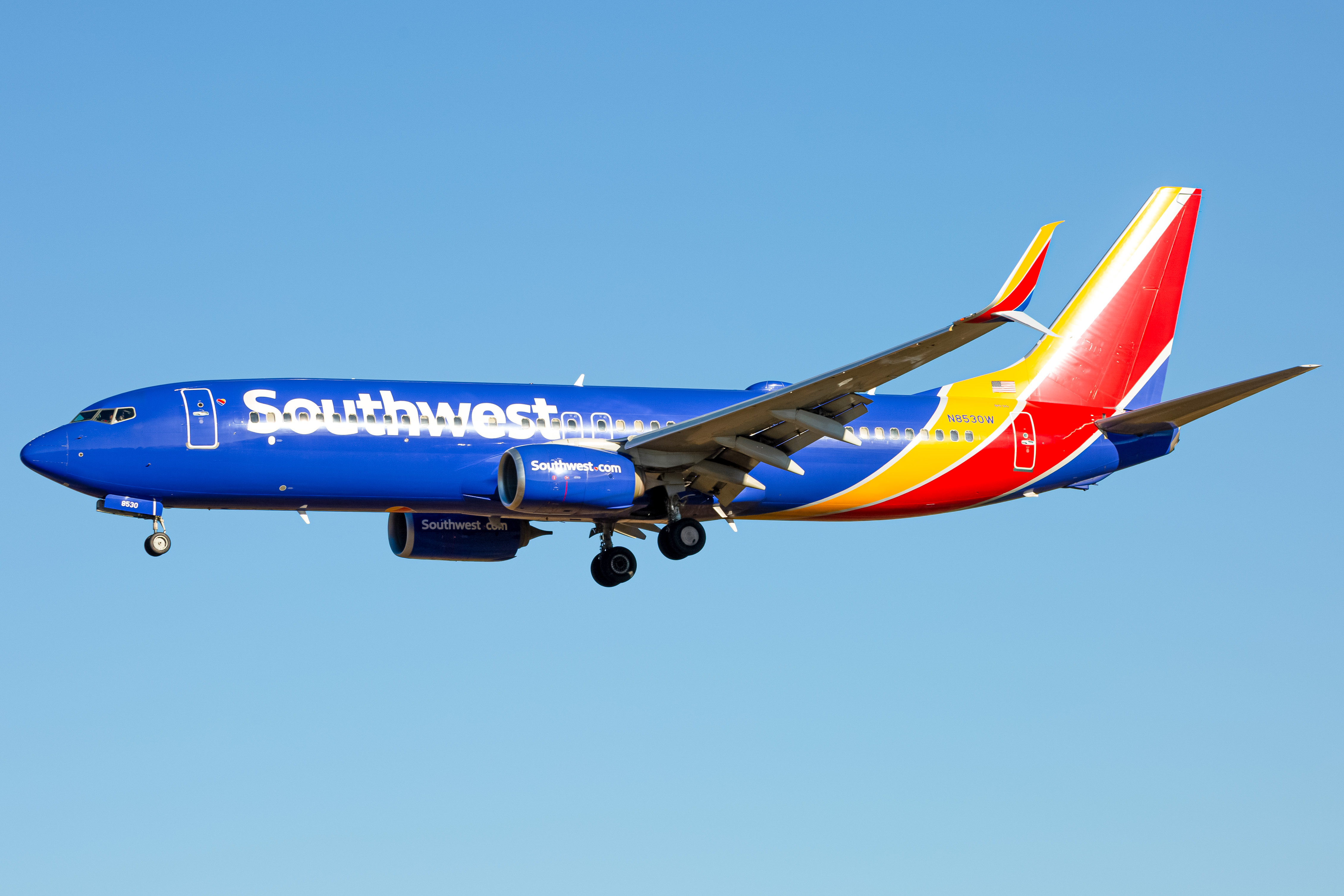

Passenger load factor, commonly abbreviated as LF, is the measure of the number of paying passengers expressed as a percentage of the aircraft's total passenger-carrying capacity. For a given flight leg, it is calculated simply by the expression:

Let's hypothesize a scenario of a low-cost carrier like Southwest Airlines, operating a Boeing 737 MAX 7 for a given route A-B. With the maximum passenger carrying capacity of the aircraft at 150, and the passengers aboard the aircraft at 70, the LF would be 46.67% (70/150 * 100). Note that the distance cancels out on both the numerator and denominator. Depending on the airline's business model, the breakeven LF for most is often at least 75%.

Considering the objective for airlines is to make profits, a 46.67% LF falls short of that. Remember, airlines have certain fixed costs such as insurance costs and salaries that have to be paid irrespective of how little revenue is generated. What if the number of paying passengers aboard the aircraft was to increase to 140 for the same flight? Then the LF would be a whopping 93%. With similar considerations that the airline needs to pay off the fixed costs, among many more, then this LF would be the ideal deal-maker. Notably, this is for rather obvious reasons:
- The airline would spread its fixed costs amongst the paying passengers. Remember, paying passengers normally match the number of occupied seats, and could differ from passenger head counts, which could even include infants.
- The airline, specifically the key stakeholders such as the management and investors, can determine the revenue generation and profitability of the airline.

To put the 75% LF in perspective, in 2021, Southwest Airlines held an average load factor of 78.5%, Delta Air Lines held 69%, American Airlines held 73.5%, and United Airlines held 72.2%. Notably, Delta's turned a $280 million profit in 2021, while American was unprofitable. Ultimately, there are many Key Performance Indicators (KPIs) for airlines. A higher LF is probably the first step in the right direction to analyze and forecast next steps, even if it doesn't directly correlate to profitability as that relies on additional outside metrics and business model structures.
Tourist Plane Crash in Peru Claims 13 Lives Near Nazca Lines » UK Startup Invents New Way to Load Cargo Planes From Below, Not the Side » This Week in Aviation: The 10 Stories That Mattered Most »

Comments (0)
Add Your Comment
TAGS
INFORMATIONAL InformationalEducationalLoad FactorsTravelAir TransportAir TravelRECENTLY PUBLISHED
 BALPA Warns of Uncommanded Engine Shutdowns from Fire Switch Release
British pilots' union BALPA raises alarm over fire switch fault that can cause uncommanded engine shutdowns on Airbus A350 and A320neo jets.
NEWS
READ MORE »
BALPA Warns of Uncommanded Engine Shutdowns from Fire Switch Release
British pilots' union BALPA raises alarm over fire switch fault that can cause uncommanded engine shutdowns on Airbus A350 and A320neo jets.
NEWS
READ MORE »
 Maxon: The Engineering Secret Behind Fly-by-Wire Control
Discover how force-feedback motors give pilots tactile control in fly-by-wire aircraft and how integrated drive systems improve performance, testing, and reliability.
INFORMATIONAL
READ MORE »
Maxon: The Engineering Secret Behind Fly-by-Wire Control
Discover how force-feedback motors give pilots tactile control in fly-by-wire aircraft and how integrated drive systems improve performance, testing, and reliability.
INFORMATIONAL
READ MORE »
 FAA Certifies Boeing 737 MAX-7 After Nearly Decade-Long Review
The FAA has certified Boeing's 737 MAX-7 after nearly 10 years of review, clearing the smallest MAX variant for commercial airline service.
NEWS
READ MORE »
FAA Certifies Boeing 737 MAX-7 After Nearly Decade-Long Review
The FAA has certified Boeing's 737 MAX-7 after nearly 10 years of review, clearing the smallest MAX variant for commercial airline service.
NEWS
READ MORE »
More than just headlines.
Get unlimited ad-free access to in-depth aviation news, premium stories, and exclusive insights other sites don't cover.
- Ad-free browsing on AeroXplorer
- Unlimited access to premium and exclusive articles
- Higher photo upload limits & commissions on sales
- Free access to Jetstream Magazine on higher tiers
- Ad-free browsing
- Sell aviation photos with 60% commission
- First week free!
- Everything in Basic+
- Unlimited premium articles
- Sell aviation photos with 70% commission
- Free Digital subscription to Jetstream Magazine
- First week free!
- Everything in Basic+ and Pro
- Sell aviaiton photos with 80% commission
- Early access to exclusive stories
- Free Digital+Print subscription to Jetstream Magazine