A serious aviation safety incident unfolded in the skies just north of Nashville International Airport on the afternoon of Saturday, April 18, 2026, when two Southwest Airlines jets came perilously close to colliding in mid-air after an air traffic controller inadvertently directed one aircraft into the path of another. The near-miss, which brought the two Boeing jets within approximately 500 feet of one another, was prevented only by the split-second response of both flight crews acting on Resolution Alerts from their Traffic Collision Avoidance Systems. The Federal Aviation Administration has now launched an investigation.
What Happened in the Sky Over Nashville
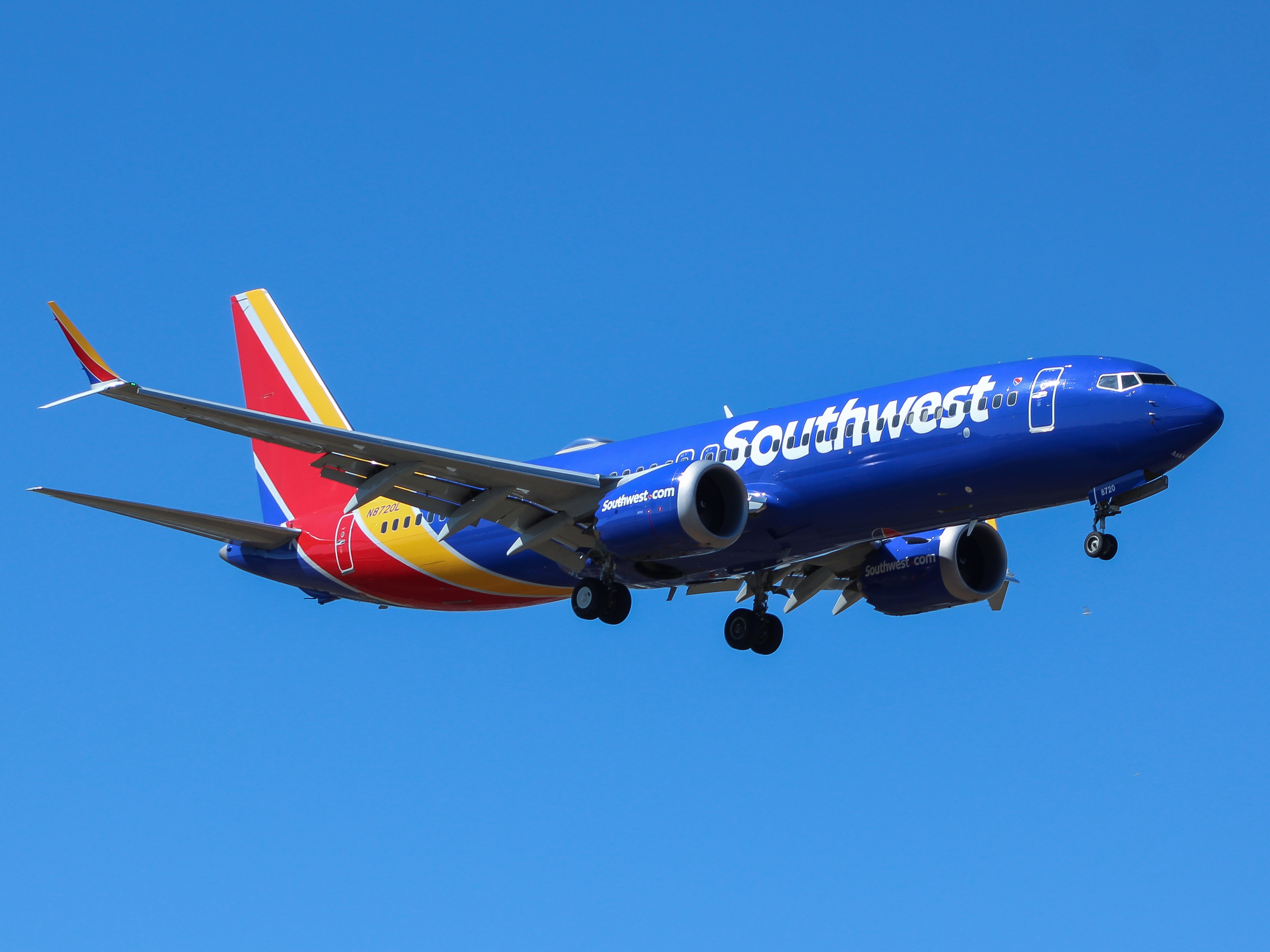
Two Southwest Airlines jets were forced to take evasive action late Saturday afternoon just north of Nashville International Airport to avoid a potential midair collision. A review of air traffic data and ATC recordings indicates that a controller inadvertently turned a Southwest Boeing 737 MAX 8 into the path of a Southwest Boeing 737-700 that was taking off from the airport. Pilots in both aircraft indicated that they took evasive action in response to Resolution Alerts from their onboard collision avoidance systems.
The MAX 8 aircraft, Southwest Flight 507, was heading from Myrtle Beach to Nashville and had been cleared to land on Runway 2 Left. For unknown reasons, the data suggests the flight crew decided to execute a "go-around" instead of landing. At the same time, the 737-700, Southwest Flight 1152, was taking off for Knoxville from Runway 2 Right, just to the east of the other aircraft.
What followed was a cascade of errors under pressure. Seconds later, the air traffic controller directed Flight 507 to turn right, putting it into a potential conflict with Flight 1152. Apparently realising his mistake, the controller suddenly ordered Flight 507 to climb from 2,000 feet altitude to 3,000 feet, while directing Flight 1152 to hold at 2,000 feet.
The exchange captured on ATC recordings lays bare the confusion that followed. The controller answered, "He's already in the turn. Flight 507, descend and maintain 2,000." "Down to 2,000," Flight 507 quickly shot back.
A short time later, Flight 1152 informed the controller, "We are out of the RA." Flight 507 acknowledged it had also responded to the Resolution Alert from its collision avoidance system.
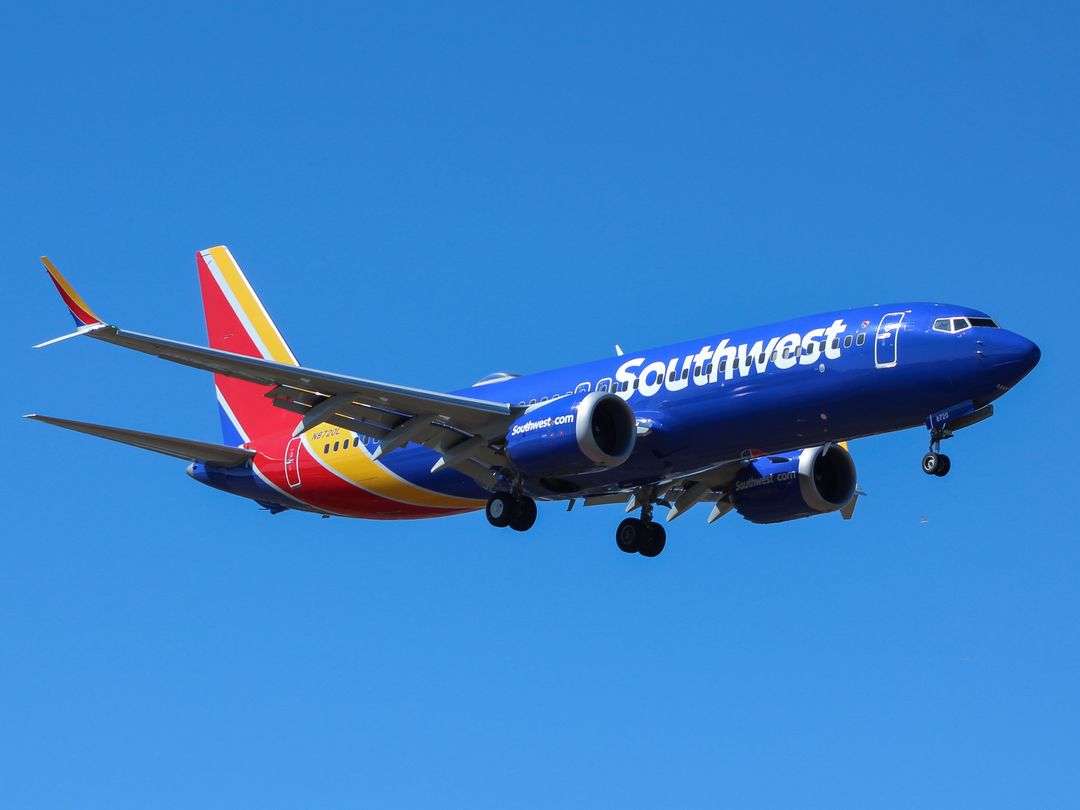
Photo: AeroXplorer/ Jared Jamel
How Close Was Too Close
The 500-foot separation figure is not a rounding estimate; it represents a margin so slim that it places this incident firmly in the category of serious airspace conflicts, not minor ATC miscommunications. Standard vertical separation requirements in US airspace at low altitudes require a minimum of 1,000 feet between aircraft. At half that distance, with both jets in motion and one executing a go-around turn at the controller's instruction, the outcome was entirely dependent on TCAS functioning as designed and both crews acting without hesitation.
Resolution Alerts are generated by Traffic Collision Avoidance System devices that are on all commercial aircraft. Typically, TCAS alerts instruct one aircraft to climb while directing the other to descend. The system operates independently of ground-based air traffic control, meaning it provides a final safety net precisely for moments when ATC instructions have already created a conflict rather than prevented one.
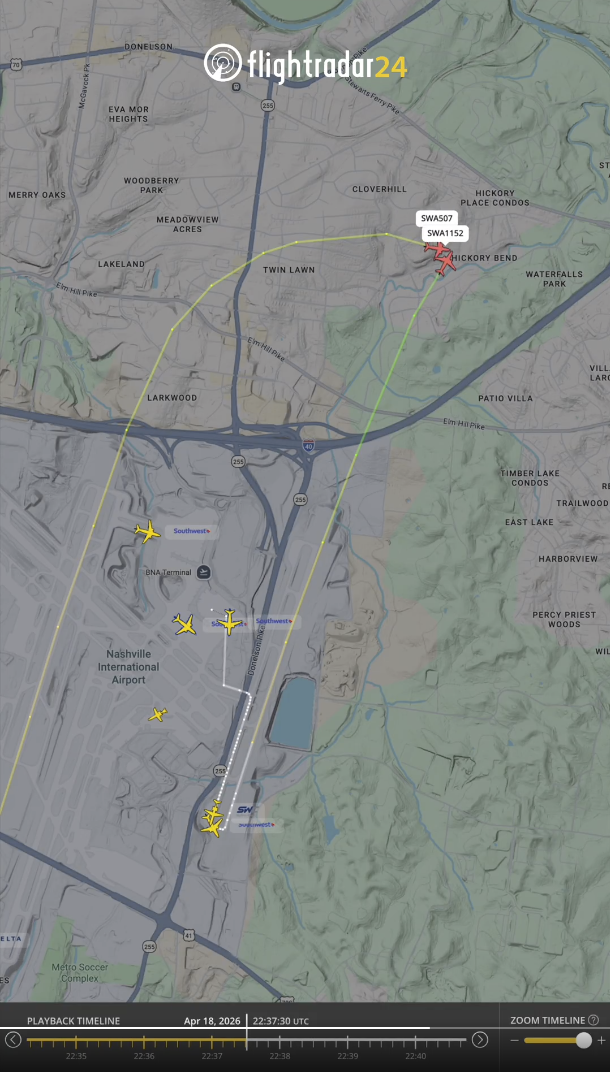
Photo: Flightradar24
Southwest's Official Response
Southwest Airlines moved quickly to confirm the incident and acknowledge the investigation. The airline released a full statement:
"While on approach during gusty winds at Nashville International Airport on Saturday, the Pilots of Southwest Flight 507 executed a precautionary go-around. During the go-around, the Pilots complied with instructions from air traffic control and an onboard traffic alert to avoid conflicting with Southwest Flight 1152, which was departing from another runway. Flight 507 landed uneventfully after the go-around, and Flight 1152 continued to Knoxville."
The airline added:
"We are engaged with the FAA as part of the investigation. Southwest appreciates the professionalism of its Pilots and Flight Crews in responding to the event. Nothing is more important to Southwest than the Safety of our Customers and Employees."
The airline's reference to gusty wind conditions partially explains why Flight 507 initiated the go-around. Pilots landing in strong crosswinds exercise the right to discontinue an approach if conditions deteriorate below acceptable thresholds, a standard and entirely correct procedure. What transformed a routine go-around into a near-catastrophe was the controller's subsequent vectoring of the aircraft into occupied airspace.

Photo: AeroXplorer/Harrison Bacci
The ATC Staffing Crisis Backdrop
This near-miss does not occur in a vacuum. The United States has been grappling with a chronic shortage of certified air traffic controllers for several years, a situation that has placed mounting pressure on the controllers in service and reduced the safety margins that adequate staffing would otherwise provide. In response to increased near-misses, the FAA attributed heightened incidents to air traffic control staffing issues, inexperienced pilots, and outdated technology. According to the FAA, as of December 2023, there were around 1,000 fewer certified controllers than there had been a decade ago, although 1,500 new controllers were hired and an additional 2,600 controllers were placed "at various levels of training at air traffic facilities across the country."
Southwest itself has faced heightened regulatory scrutiny over a cluster of safety incidents in recent years. The Federal Aviation Administration placed Southwest Airlines under a heightened safety review after a string of near-miss safety incidents involving the low-cost carrier, amid ongoing concerns about the state of US aviation.
The Nashville incident, in which an ATC instruction was the direct proximate cause of the conflict rather than a pilot error or mechanical failure, adds a dimension to that scrutiny that goes beyond any single airline's safety record. It points to a systemic vulnerability in the US air traffic management system that no airline, however well-trained its crews, can fully compensate for.

Analysis: How Spirit Airlines Changed Airline Pricing, then Paid the Price
A Broader Pattern of Concern
Nashville International Airport has now featured in more than one serious ground or airspace safety incident in recent years. A September 2024 runway incursion at the same airport involved an Alaska Airlines jet and a Southwest aircraft, when quick braking by the Alaska crew prevented a collision on the runway surface itself. The April 18 incident represents a different threat category, an airspace conflict in the departure and approach corridors, but the recurrence of serious events at the same facility is likely to draw attention from investigators examining whether there are specific procedural or environmental factors at Nashville that require targeted intervention.
Both Flight 507 and Flight 1152 completed their journeys safely. No passengers or crew members were injured. Flight 507 landed uneventfully after the go-around, and Flight 1152 continued to Knoxville. The FAA investigation is ongoing.
Southwest Airlines Flights Involved
| Flight No. | Route | Departure Time | Arrival Time | Duration | Operating Days |
|---|---|---|---|---|---|
| WN507 | Myrtle Beach (MYR) → Nashville (BNA) | ~2:30 PM ET | ~4:15 PM CT | ~2h 45m | Daily |
| WN1152 | Nashville (BNA) → Knoxville (TYS) | ~4:20 PM CT | ~5:05 PM CT | ~45m | Daily |
Note: Both flights completed their journeys safely following the incident. WN507 landed after executing a go-around; WN1152 continued to Knoxville. Times are indicative based on published schedule data for the April 18, 2026, operations. Passengers should always verify current schedules directly with Southwest Airlines.
What the Investigation Must Determine
The FAA's inquiry will need to answer several critical questions. First, why did Flight 507's crew initiate a go-around when cleared to land, and whether wind data at the time justified that decision or whether the go-around itself was unexpected by the controller. Second, and more significantly, why did the controller turn Flight 507 to the right toward occupied airspace rather than away from it, a direction that brought it directly into conflict with the climbing departing aircraft? Whether the controller was experiencing fatigue, a high workload, or was inadequately experienced for the complexity of the traffic environment at that moment will all be key lines of inquiry.
What is already clear from the ATC recordings is that the controller recognised the mistake rapidly and attempted to correct it, but the correction itself arrived in conflicting form, first ordering a climb, then a descent, within seconds. That oscillation in instruction is precisely the scenario TCAS is engineered to resolve when human decision-making cannot keep pace with the speed at which the conflict is developing. On April 18, the system worked. The investigation must ensure that the conditions that made the system necessary are not allowed to persist.
How Ryanair and Alaska Airlines Are Using AI to Make Real Decisions, Not Just Predictions » GA-ASI Introduces Purpose-Built Wildfire UAS for Aerial Firefighting Missions » Frontier Airlines Passengers Stranded Overnight After Crew Timeout From Weather Diversion »

Comments (0)
Add Your Comment
TAGS
NEWS Southwest Airlines Nashville Airport Near Miss Air Traffic Control FAA Investigation Boeing 737 MAX 8 Boeing 737-700 Aviation Safety Go-Around · ATC Error BNA Airport Midair Near CollisionRECENTLY PUBLISHED
 NBC NewsChopper 4 Crash in Los Angeles Kills Three, Injures Two While Covering Fatal Bus Collision
An NBC News helicopter crashed in Chatsworth while covering a fatal LA bus collision, killing three and injuring two others in a devastating incident.
NEWS
READ MORE »
NBC NewsChopper 4 Crash in Los Angeles Kills Three, Injures Two While Covering Fatal Bus Collision
An NBC News helicopter crashed in Chatsworth while covering a fatal LA bus collision, killing three and injuring two others in a devastating incident.
NEWS
READ MORE »
 Amazon Suspends Cargo Carrier 21 Air After Deadly Miami Runway Crash
Amazon has halted operations with cargo carrier 21 Air following a Prime Air plane crash near Miami that killed multiple crew members.
NEWS
READ MORE »
Amazon Suspends Cargo Carrier 21 Air After Deadly Miami Runway Crash
Amazon has halted operations with cargo carrier 21 Air following a Prime Air plane crash near Miami that killed multiple crew members.
NEWS
READ MORE »
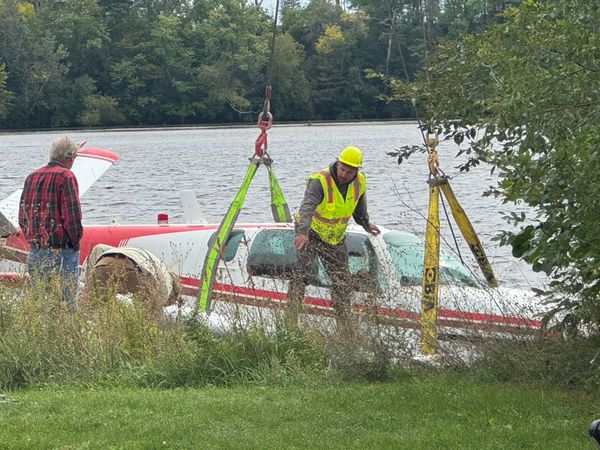 Congressman Tom Tiffany Survives Emergency Plane Landing in Lake Wausau
Wisconsin Rep. Tom Tiffany walked away unharmed after his small plane made an emergency landing in Lake Wausau. The FAA has opened an investigation.
NEWS
READ MORE »
Congressman Tom Tiffany Survives Emergency Plane Landing in Lake Wausau
Wisconsin Rep. Tom Tiffany walked away unharmed after his small plane made an emergency landing in Lake Wausau. The FAA has opened an investigation.
NEWS
READ MORE »
More than just headlines.
Get unlimited ad-free access to in-depth aviation news, premium stories, and exclusive insights other sites don't cover.
- Ad-free browsing on AeroXplorer
- Unlimited access to premium and exclusive articles
- Higher photo upload limits & commissions on sales
- Free access to Jetstream Magazine on higher tiers
- Ad-free browsing
- Sell aviation photos with 60% commission
- First week free!
- Everything in Basic+
- Unlimited premium articles
- Sell aviation photos with 70% commission
- Free Digital subscription to Jetstream Magazine
- First week free!
- Everything in Basic+ and Pro
- Sell aviaiton photos with 80% commission
- Early access to exclusive stories
- Free Digital+Print subscription to Jetstream Magazine