
On Friday, April 5, a magnitude 4.8 earthquake rocked eastern New Jersey, causing buildings to shake for up to 30 seconds. The shaking was felt as far North as Albany in New York and south as Wilmington in Delaware. Following the earthquake, there were no reported deaths or injuries; the only damage to be noted was weaker buildings. Friday’s earthquake was one of the largest felt across the Northeast in recent years.

Ground Stops
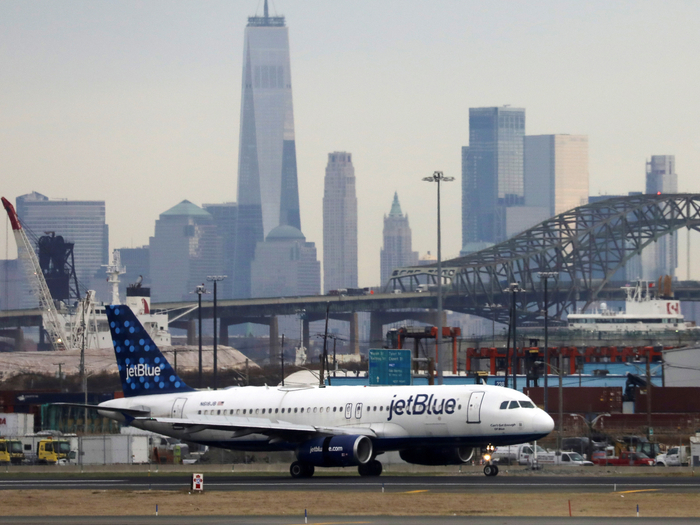
The Federal Aviation Administration (FAA) issued ground stops at the airports closest to the epicenter in response to the earthquake. The airports affected by ground stops included Newark Liberty Int’l Airport (EWR) and New York John F. Kennedy Int’l (JFK). The FAA ground stop was issued as a precaution while workers at these airports assessed airport facilities for any damage caused by the brief earthquake.
The ground stop at JFK was lifted first at around 11:10 a.m. local time, while the EWR ground stop was lifted around 20 minutes later at 11:30 a.m. local time. Delays at JFK following the ground stop were less significant than in Newark, with JFK reporting an average 20-minute delay for flights departing the airport. In Newark, however, for some unlucky flights, this delay time was as high as one hour.

During earthquakes, it is standard operating procedure for airport facilities to cease operations while the tremors occur. Some airports, such as those in Japan, are prone to powerful, long earthquakes, but they are built to withstand more powerful quakes and have developed procedures to follow after a powerful earthquake. At Narita Airport (NRT) in Tokyo, if an earthquake of a certain magnitude or greater is detected, an announcement will sound, notifying passengers to stay calm and away from windows, walls, and pillars.
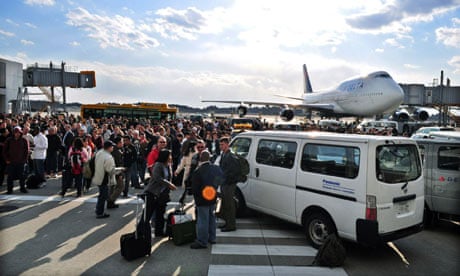
If an earthquake is powerful enough in Japan, the terminal buildings will be evacuated, with airport employees bringing passengers outside on the tarmac. Following the Tōhoku earthquake in March 2011, all flights out of Japanese airports north of Tokyo were canceled.
Most airports in Asia along the so-called "Ring of Fire" are built to an extent to withstand strong earthquakes. Following the April 4 Hualien City earthquake in Taiwan, air travel out of many of Taiwan's major international airports continued as normal, with only minor damage and delays reported from airlines. Some airports in Southern Japan were closed temporarily following the earthquake but have since reopened with minimal disruptions.
Most aircraft landing gears are built with shock absorbers to withstand hard landings. This means that an aircraft's landing gear will absorb most of the quake's tremors during an earthquake, leading to the aircraft being unaffected and undamaged.
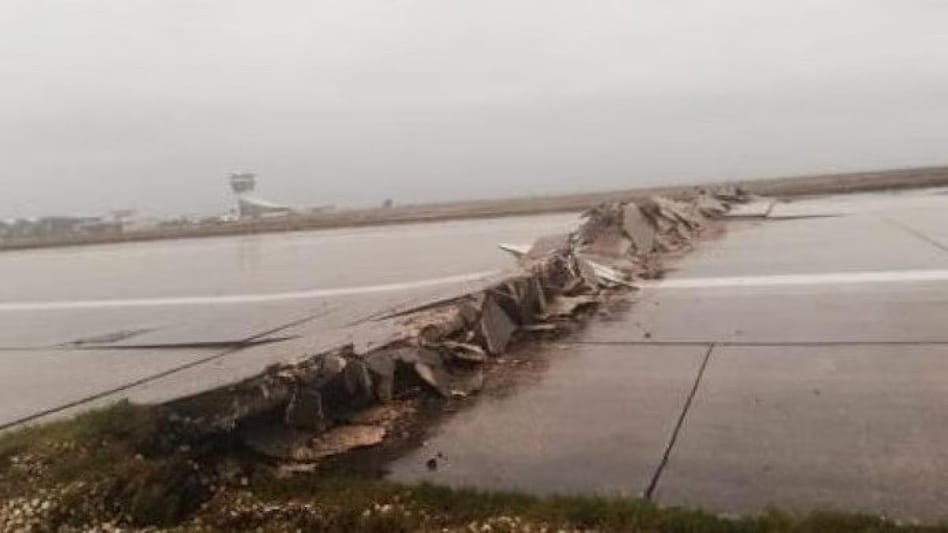
Besides potentially affecting airport buildings and the sensitive radio and electrical equipment inside them, earthquakes can also affect airport runways through a process known as liquefaction. Liquefaction occurs when the rapid shaking of the ground during an earthquake causes the soil underground (typically soil with a higher amount of water) to act as a liquid. Liquefaction can no longer support the weight above it.
This means that if an earthquake is powerful enough to cause the liquefaction of the soil beneath an airport runway, the runway will crack and buckle, leaving it unusable to air traffic afterward. Certain organizations, such as Oregon State University, are studying the effects a major earthquake might have on U.S. airports - in this case, Portland Intl Airport (PDX) in Oregon.
Handheld X-Ray for MRO Featured at Farnborough: Videray PX Range » FAA Warns Boeing 737 MAX Seat Failure Could Endanger Passengers » airBaltic Launches Swiss Subsidiary to Expand Pilot Employment and ACMI Operations »

Comments (0)
Add Your Comment
TAGS
NEWS Earthquake New York EWR JFK United Airlines American Airlines FAA United States Delta Air Lines New Jersey Ground StopRECENTLY PUBLISHED
 airBaltic Launches Swiss Subsidiary to Expand Pilot Employment and ACMI Operations
airBaltic sets up a Swiss subsidiary to employ pilots under local contracts, supporting its growing international ACMI wet-lease business.
NEWS
READ MORE »
airBaltic Launches Swiss Subsidiary to Expand Pilot Employment and ACMI Operations
airBaltic sets up a Swiss subsidiary to employ pilots under local contracts, supporting its growing international ACMI wet-lease business.
NEWS
READ MORE »
 Southwest Airlines Partners With Chase to Launch Co-Branded Airport Lounges
Southwest Airlines confirms plans to open premium airport lounges co-branded with Chase, marking a major shift for the traditionally no-frills carrier.
NEWS
READ MORE »
Southwest Airlines Partners With Chase to Launch Co-Branded Airport Lounges
Southwest Airlines confirms plans to open premium airport lounges co-branded with Chase, marking a major shift for the traditionally no-frills carrier.
NEWS
READ MORE »
 SWISS A330 Bound for New York Diverts to Bangor After Smoke Fills Business Class Cabin
A SWISS Airbus A330 flying from Zurich to New York made an emergency landing in Bangor, Maine, after smoke filled the business class cabin.
NEWS
READ MORE »
SWISS A330 Bound for New York Diverts to Bangor After Smoke Fills Business Class Cabin
A SWISS Airbus A330 flying from Zurich to New York made an emergency landing in Bangor, Maine, after smoke filled the business class cabin.
NEWS
READ MORE »
More than just headlines.
Get unlimited ad-free access to in-depth aviation news, premium stories, and exclusive insights other sites don't cover.
- Ad-free browsing on AeroXplorer
- Unlimited access to premium and exclusive articles
- Higher photo upload limits & commissions on sales
- Free access to Jetstream Magazine on higher tiers
- Ad-free browsing
- Sell aviation photos with 60% commission
- First week free!
- Everything in Basic+
- Unlimited premium articles
- Sell aviation photos with 70% commission
- Free Digital subscription to Jetstream Magazine
- First week free!
- Everything in Basic+ and Pro
- Sell aviaiton photos with 80% commission
- Early access to exclusive stories
- Free Digital+Print subscription to Jetstream Magazine